The Theatre Field Should Adopt Free and Open-Source Software for Resilience, Sovereignty, and Coherence


These corporations and their products are not accountable to us, nor will they ever be. They are not designed to be. In fact, it is their job to be at the meeting in the Oval Office in order to maneuver a competitive advantage for their stakeholders.
The problem here is that we don’t get to have a voice or a vote in this everyday software. They never asked us what we needed, and we didn’t get to deliberate on whether we wanted to get addicted, manipulated, tracked, surveilled, profiled, sold, marketed to, and used to train their generative AI models.
If this were a person doing these things to us, it would be called an abusive relationship.
A Mismatched Partnership for Our Prosocial Work
As people who are trying to make art and culture that is aligned with justice and livable, desirable futures, we have needs that are not a good match for proprietary software. To quote the foundational impulse for the United States nonprofit theatre movement as articulated by Arena Stage co-founder Zelda Fichandler:
Once we made the choice to produce our plays not to recoup an investment but to recoup some corner of the universe for our understanding and enlargement, we entered into the same world as the university, the library, the museum, and the church, and became, like them, an instrument of civilization.
Proprietary software will have a hard time dismantling ableist, racist, sexist, and other systems of oppression. And the corporations that own it will have a hard time listening to us because they have other priorities: profit, monetizing, monopolizing their niche, etc.
Like nonprofit theatre, Big Tech seeks to be “an instrument of civilization,” but at a megalomaniacal scale. Their project is a worldmaking one, which they have successfully advanced over the past several decades by reshaping our behaviors and relationships with technology that impact most of our waking hours.
There is a quasi-religious desire by many of the leaders of Big Tech to seek complete overhauling of the human being and the human civilizational project, potentially at the cost of viable earth-bound futures for everyone. Their hoped-for god is the property of the few, not the public.
There is a quasi-religious desire by many of the leaders of Big Tech to seek complete overhauling of the human being and the human civilizational project, potentially at the cost of viable earth-bound futures for everyone. Their hoped-for god is the property of the few, not the public.
However, the nonprofit theatre’s view of itself as an “instrument of civilization” is about human social and personal development. It evolves from a grassroots level of local geography, led by civil society groups with none of the top-down autocratic political and marketing power that Big Tech wields.
There is a mismatch between what the nonprofit theatre sector stands for and what corporate technology can offer. Consider the example of accessibility. Ableism is a baked-in trait of our digital systems. Capitalism can only view disability as revenue potential. Those are the rules of the economic system to which proprietary software belongs. The market by itself has insufficiently met the needs of people with disabilities because there is not enough earning potential there, so historically we have needed to fight the uphill battle for laws and regulations creating equitable access for disabled people. These laws and regulations have helped to make software more accessible, but managers overseeing products and services for public use view these regulations as burdensome rather than as a desirable worldview shift and orientation that centers inclusion as its primary design principle.
Given that we are in a moment in which the United States government is dismantling laws and attacking immigrant, women, queer, and disability communities, it is uncertain whether proprietary software and their corporations will have any incentive to become ideal partners in our work as culture professionals who are of those targeted communities.
Defining Free and Open-Source
There is a lot of history, nuance, and debate in the terms “free software” and “open-source software,” but for our purposes these terms are basically synonymous. “Free software” refers to software that respects users’ freedom and the community that collaboratively built the software. It means that the users have the freedom to run, copy, distribute, study, change, and improve the software. The word “free” here is about freedom, not about monetary cost. This software is also known as “free/libre and open-source software” in order to clarify the meaning. “Open-source” refers to the fact that the source code is transparent and publicly accessible. It also implies a distributed, collaborative development process and an invitation for volunteers to collaborate.
Google’s Gmail is not free software. However, it does not cost you anything (except for much of your privacy and some cognitive skills if you accept their generative AI).
Free software is the opposite of proprietary software: The makers of proprietary software artificially create scarcity and restrict access in order to control and monetize their products. Interestingly, however, free software is not allergic to monetization and is able to coexist with and support business models built on top of it through hosting, deployment, and other consulting services. Several for-profit corporations use free software as a core foundation to their service offerings. For example, Automattic contributes to the free/libre and open-source WordPress website software, and LG relies on Linux for their smart TV software.
Free and open-source software is software that grants the user freedoms and in practice belongs to anyone. Like natural human languages, it’s a common resource that you can use and modify. Or, like Wikipedia—a collectively created knowledge commons—it’s available to anyone.
Where Do We Have Power? How Do We Build Together?
Luckily, we actually have a lot of choice. There are viable alternatives to most proprietary software, and where there is not, it is possible to build them.
HowlRound Theatre Commons has gone on a journey of becoming increasingly frustrated with Big Tech platforms and slowly, deliberately making a path towards adopting free and open-source software in our operations. The PeerTube project has majorly figured into our learning about how to effectively participate and contribute to open-source software as people who are not coders, but who have a lot to offer in terms of knowing our community’s needs and being guided by a set of values.
PeerTube is a commons-based alternative to the Big Tech platform YouTube. It is free and open-source software that anyone can run on a server that they manage or rent themselves, or they can choose to join a publicly available community server. It has the same general features as YouTube, such as video hosting and livestreaming. Instead of being centralized and owned by Google and Alphabet, and therefore being part of their wealth pump for user data exploitation, monetization, and advertising, PeerTube puts the control, privacy, and ownership in users’ hands.
Instead of being centralized and owned by Google and Alphabet, and therefore being part of their wealth pump for user data exploitation, monetization, and advertising, PeerTube puts the control, privacy, and ownership in users’ hands.
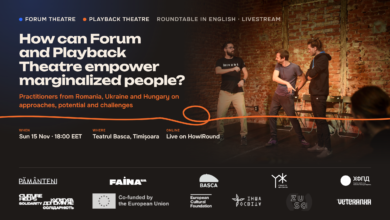
HowlRound TV, which is our livestream and video archive project, invites theatre organizations around the world to contribute a livestream of their events for the benefit of theatre practitioners who are not local. Our organization’s role is to support their communications, publishing, and archiving of their livestream event on the HowlRound website.
Prior to switching to PeerTube, we used two vendors. The first was Livestream back in 2010. That worked out for a few years. Then, Vimeo, another private company, bought Livestream and decided to phase out Livestream’s technology in favor of Vimeo’s in-house livestream capabilities, which were inferior. This regression in features and services was beyond our control.
Vimeo was also preoccupied with corporate re-structuring as they were becoming a publicly traded corporation. Features that we depended on previously, such as live analytics and stats, were not working as we expected them to work. We had no ability to impact the way that the software could be debugged or improved. We were truly at the whim of this very popular service provider, and we didn’t have the knowledge or expertise at that moment to figure out how to escape. We were involved in “vendor lock-in” due to our lack of knowledge of alternatives.
During this frustrating many months, we realized that this service provider was not going to be a good partner in what we’re doing. We then started to research. Luckily, we were getting exposed to great open-source software for producing livestreams (OBS Studio, vdo.ninja, Jitsi). What we needed was an alternative livestream host.
We set out to look for open-source platforms that were mission driven and stewarded by a noncommercial institution or entity. We found the PeerTube software project, which is stewarded by Framasoft, an organization based in France that promotes free, commons-based culture; hosts free software; and resists surveillance capitalism. Instead of paying an expensive enterprise subscription to Vimeo, we used that money to contract the lead developer of PeerTube to install and update PeerTube for our organization. Participation in this open-source project meant transferring extra financial resources to the developers, some of whom are paid by Framasoft and some who are voluntary developers on the project.
Our PeerTube instance, or server, became the shared livestreaming infrastructure for the theatre organizations that we support and partner with. The benefits were immediate. We were no longer in a customer relationship with a corporation. Instead, we were an active participant in the development, support, and growth of this software commons. If there was a bug, we could report it. If there was a feature request, we could request it. Usually, as long as these requests remained within the mission of the software project, they would be fulfilled pretty quickly and expertly.