 The Schaefer family started visiting the Adirondacks in the early 1920s to find relief for the asthma symptoms of Rose Schaefer.
The family enjoyed outdoor activities of all kinds, including winter sports.
Several of Rose and her husband Peter Schaefer’s would become important Adirondack figures. Their oldest, Vince Schaefer became an atmospheric scientist at General Electric; Paul Schaefer became a noted Adirondack preservationist (his home in Niskayuna is now Union College’s Kelly Adirondack Center and Adirondack Research Library); and Carl Schaefer helped create New York State’s first rope tow ski lift.
Carl joined the American Legion group that explored the old logging roads on Gore Mountain with a view towards clearing them for ski trails.
As a member of the Schenectady Wintersports Club (along with his sisters Gertrude and Peggy), he was one of the 378 skiers on the first Snow Train to North Creek on March 4, 1934.
His friend and mentor William (Bill) Gluesing, who led General Electric’s “House of Magic” stage show and science education program which showcased cutting-edge electrical and scientific research, took 16mm films of Snow Trains and early skiing.
 He coined the phrase “Ride Up-Slide Down” to describe the experience of skiers taking buses, trucks, and cars to the Barton Garnet Mine before skiing back to town.
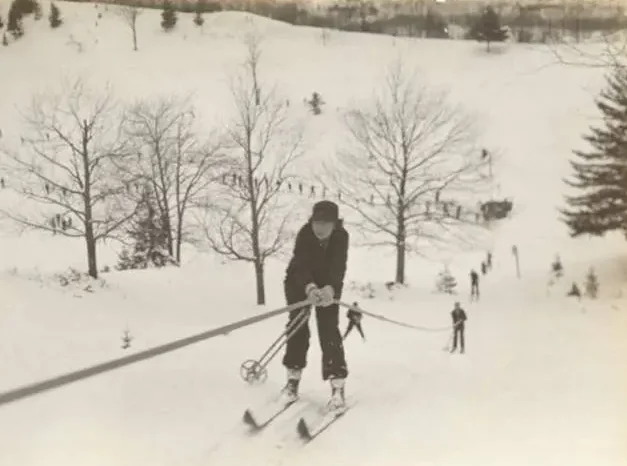
In 1935, Bill gave Carl $100 to build a rope tow at the McMahon Ski Bowl (forerunner of North Creek Ski Bowl). With the help of his friend Gene Morehouse and the Alexander Garage, Carl converted a 1929 Buick to pull skiers up the hill for the 1935-1936 season.
Skiers no longer had to negotiate a five-mile downhill run to enjoy a day of skiing. This was the first rope tow in New York State, and the second in the Northeast. (The first opened in January 1934 on Clinton Gilbert’s farm on Gilbert’s Hill in Woodstock, Vermont.)
Carl also started the North Creek Ski School, the first in the area.
The following season, Carl moved his rope tow to the property he had purchased and created the “Skiland” ski area, located near the future Gore Mountain Ski Center.
 He had a rope tow, skating rink, ski jump, toboggan run, and youth hostel. He operated the area for several years before returning to Schenectady to raise his family.
Other rope tows proliferated in the North Creek area. Emmett Higgins and Burt “Bucky” Burns built a new tow at the Ski Bowl to replace the Schaefer tow.
Others included Straight’s, Barton’s, and the Log House tows in North River, and the White Horse in Wevertown. The inexpensive uphill lifts proved very popular, and added another dimension to the “Ride Up-Slide Down” activities in North Creek.
Read More About Skiing in New York
The essay by Greg Schaefer was first published in the North Creek Depot Museum Newsletter (Spring/Summer, 2025).
The North Creek Depot Museum is located on the Hudson River in the Warren County hamlet of North Creek in the Adirondacks. The restored 1872 railroad depot is where Vice President Theodore Roosevelt learned he would become the 26th U.S. President following the assassination of William McKinley in 1901. The museum also chronicles the Gore Mountain Region’s history including its role in pioneering the ski industry in America.
Illustration, from above, courtesy the author’s collection: Carl Schaefer’s first ski rope tow in New York State, Jan 11, 1936 (photo courtesy of Greg Schaefer); Detail from photo of rope tow, 1936; and Margaret Cunningham is using the Schaefer rope tow, ca. 1936.
Source link