 As a stamp collector, I keep coming back to a small set of six stamps from 1901. They were printed in Washington, but their story belongs to Buffalo. They advertised the city’s great world’s fair, they carried the fair’s message about modern transportation into mailboxes across the country, and three of them became famous for a printing mistake that turned a picture upside down.
The Pan-American Exposition is remembered for its lights and for the tragedy at the Temple of Music. Its stamps deserve a place in that memory too.
Buffalo in 1901
The Pan-American Exposition ran from May 1 to November 2, 1901. Buffalo won the fair because of its size and its rail connections. The city had approximately 350,000 residents and ranked as the eighth largest city in the United States. Its location near Canada and Niagara Falls also mattered.
 The exposition set out to celebrate the nations of the Western Hemisphere and to promote cooperation and trade among them. The painted buildings earned the grounds the nickname “Rainbow City.”
The real showpiece was electricity. Power generated at Niagara Falls, roughly 25 miles away, lit the buildings each night, and the Electric Tower stood at the center of the display. Hundreds of thousands of eight-watt light bulbs outlined the buildings after dark.
The Theodore Roosevelt Inaugural National Historic Site calls it the first massive display of electric power in the United States. The exposition cost about $7 million and took 20 months to build.
More than eight million visitors passed through the gates during the six-month run. That was a large crowd by any measure, but organizers had projected twenty million, so attendance fell well short of their hopes.
A Set of Six Stamps About Speed
The Post Office Department issued a series of six bi-colored commemorative stamps on the exposition’s opening day. The exposition’s promoters had asked for the series, and the stamps served to advertise the fair as much as to honor it.
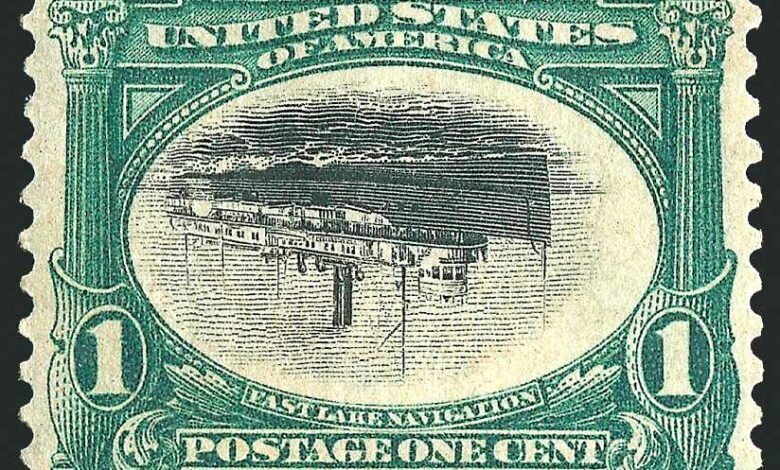
 The six stamps shared one theme, which was modern transportation. The 1-cent stamp showed the Great Lakes steamship City of Alpena. The 2-cent stamp showed the Empire State Express, a train. The 4-cent stamp showed an early electric automobile.
The 5-cent stamp pictured the bridge at Niagara Falls. The 8-cent stamp showed the canal locks at Sault Ste. Marie, and the 10-cent stamp showed an ocean-going steamship. Collectors know the set by its Scott catalogue numbers, 294 through 299.
Two of the pictures had a direct New York connection. The 5-cent stamp showed a bridge at Niagara Falls, the same falls whose power lit the exposition grounds each night.
The 2-cent stamp carried the name of the Empire State on its train. For a fair that wanted to show off the speed and reach of modern travel, the choice of subjects made sense.
The Bureau of Engraving and Printing produced the stamps, and they were its first bi-colored postage stamps. Plate blocks in the National Postal Museum carry the imprint “Bureau, Engraving and Printing” in the sheet margin. Each stamp had a black central picture, called the vignette, inside a frame printed in a color that identified the denomination.
How Three Stamps Came Out Upside Down
The two colors created the risk. A two-color stamp of this kind required two separate printings, one for the vignette and one for the frame. The National Postal Museum holds separate proof sheets from the frame plate and the vignette plate for these stamps, which shows the two-step process clearly.
After the first pass through the press, a printed sheet had to go back in for the second color. If a worker fed a sheet in upside down, the picture landed upside down inside its frame.
 That mistake happened on the 1-cent and the 2-cent values. The errors reached the public through ordinary post office sales, and they surfaced within weeks. By June 1901, newspapers were telling readers to check their mail.
On June 22, the Rawlins Semi-Weekly Republican in Wyoming told readers to watch for “Buffalo stamps with an inverted locomotive,” printed by mistake. The Honolulu Republican reported the next day that a sheet of 2-cent stamps had been printed with the express train inverted, had slipped past the inspectors in Washington, and had gone into general circulation.
The 1-cent invert has a particularly well-known discovery story. According to the standard twentieth-century reference by Max Johl and Beverly King, as quoted by the Robert A. Siegel Auction Galleries, the Carrell Jewelry Company of Bessemer, Alabama, found the inverted stamps on some of its circulars. The stamp shows the steamship sailing upside down inside a green frame.
The 4-cent invert has a different history. It was never sold through post offices. After reports of inverted stamps reached postal officials, a small number of 4-cent sheets were printed with the automobile inverted for specimen purposes, and one sheet was kept by the Post Office Department.
Some of these stamps received a hand-stamped “Specimen” marking, and many did not. Collectors today regard the 4-cent invert as a special printing rather than a regularly issued error.
 The Temple of Music
For Buffalo, the exposition’s legacy changed on September 6, 1901. That afternoon, President William McKinley stood in a receiving line at the Temple of Music. Leon Czolgosz, an anarchist, shot him twice. The next morning, the New-York Tribune filled its front page with the news and the shock in Washington.
McKinley first appeared to recover. He died on September 14 at the Milburn home on Delaware Avenue, after infection and gangrene set in. That same afternoon, Theodore Roosevelt took the oath of office in the library of the Ansley Wilcox residence in Buffalo, about a mile south of the Milburn house. Judge John R. Hazel administered the oath. The house still stands and operates as a National Historic Site.
The fair continued until November, but the mood had changed. The Buffalo History Museum now displays the gun used in the shooting. The stamps, printed months before any of this happened, now read as souvenirs of the fair’s hopeful opening.
Where to See the Stamps Today
The Smithsonian National Postal Museum in Washington, DC, holds single examples of the 1-cent and 2-cent inverts in its collection. Its online collection also includes plate blocks and proof sheets for the regular stamps. Researchers can study these records without traveling.
The inverts returned to post offices for their centennial. On March 29, 2001, the Postal Service issued a Pan-American Inverts souvenir sheet in New York, reproducing the famous errors for a new generation of collectors.
In Buffalo, the Buffalo History Museum presents the fair in its permanent exhibit, “Return to the Rainbow City: Buffalo’s Pan-American Exposition.” The museum occupies the New York State Building, which it describes as the exposition’s only permanent structure.
The University at Buffalo Libraries maintains a digital collection on the fair, and in October 2026 the university opened an exhibit drawing on its archives.
I think the inverts last in memory because they are so human. Somewhere in Washington in 1901, a printer turned a sheet the wrong way, and a picture of a Buffalo fair’s modern world flipped on its head.
More than a century later, a small steamship still sails upside down in a green frame, and it still sends people back to Buffalo’s story.
Read More About The Pan-American Exposition
Ryan Joneson runs Stamp Collectors, a free US stamp value database and marketplace, and makes stamp collecting videos as That Stamp Guy on YouTube. He is based in the Fresno, California area.
Illustrations, from above: A 1-cent Pan-American Exposition stamp with inverted center, 1901 (United States Post Office Department); the brightly lit exposition; the set of six stamps (from a private collection); the purposely inverted 2-cent stamp issued in 2001; and Arnold’s photo of the Temple of Music, 1901 (University of Buffalo Libraries).
Source link