 Linda M. Champagne (1937-2026) has passed this November following a lengthy and distinguished career as a writer, journalist, historian, artist, photographer, and activist. Her career involved many years spent in the Adirondack Mountains where she was born, raised a family, and worked as a journalist. Throughout her career, she was devoted to good local journalism, historic preservation, public education and service, and environmental protection.
Linda eventually moved from Saranac Lake to Niskayuna, New York, where she held a variety of public service and educational jobs and was appointed Niskayuna Town Historian. Among many projects, she helped to document the life of Adirondack wilderness conservationist Paul Schaefer and his work as a homebuilder in the Dutch revival and early American styles.
In 1992, Linda significantly contributed to the Park-wide commemoration of the Adirondack Park Centennial (1892-1992). Among other projects, she chronicled the Association for the Protection of the Adirondacks’ centennial conference at Sagamore Great Camp, Raquette Lake, and edited its published proceedings, Wilderness and People: The Future of the Adirondack Park.
In this 1993 publication, Linda wrote these autobiographical paragraphs:
“Linda M. Champagne was born in the hamlet of Moriah, NY in the hills overlooking Lake Champlain. For generations her family lived and worked in the eastern Adirondacks. A graduate of State University of New York at Albany, she worked initially as a reporter, photographer, and columnist at the Adirondack Daily Enterprise, Saranac Lake.
“She taught art and photography at St. Pius High School in Saranac Lake and Bethlehem Central High School near Albany. For five years she was a feature writer for New York State’s International Tourism Campaign, I Love NY.
“During the 1980 Olympic Winter Games she was stationed in Lake Placid to write Adirondack features and serve as contact person for the world press. She was associate editor for the statewide monthly magazine of the Governor’s Office of Employee Relations.
“In the 1980s she wrote the script, did field interviews, and consulted on photography for the commercial multi-media production in Lake George Village, ‘The Adirondack Adventure.’
“In addition to lecturing on Adirondack artist and author Rockwell Kent, she has created exhibits of his books, paintings, woodcuts and lithographs for Schenectady Museum, colleges and public libraries. With friends and family, including four children, she has camped along lakes and hiked many Adirondack trails.”
Linda was an activist for historic and nature preservation campaigns in Albany, Schenectady, and in the Adirondacks. In 2002 she hiked Mt. Marcy to photograph and write about a re-enactment of the famous 1932, unplanned, and consequential meeting on that summit of wilderness champions Bob Marshall and Paul Schaefer.
As local historian, she felt it was her role to speak out when historical resources would be impacted by development, such as when the Ingersoll homestead was threatened by a shopping mall in Niskayuna.
That activist role caused a political stir and resulted in her being fired as Town Historian.The own remained without a municipal historian for four years.
 When the historic Niskayuna train station on the shores of the Mohawk River was threatened with destruction, she also helped to save it and place it on State and National Register of Historic Places. And she championed the nearby Lisha Kill Nature Preserve.
She was an organizing member of the Hadley Mountain Firetower Committee in Hadley, which teamed with NYS DEC Forest Rangers, local residents, and businesses to restore the firetower for public use and to hire educational mountain stewards to greet hikers on the mountain’s summit. She also edited the Hadley Firetower Committee’s annual newsletter.
She devoted herself to interviewing and later videotaping people she felt would be of interest to historic research about the Adirondacks.
These oral histories included her 1967 interview with Adirondack hermit Noah Rondeau in Lake Placid; her 1960s interview with Rockwell Kent at his Adirondack home; her 1984 interview with Adirondack conservationist Clarence Petty at his home in Corey’s near Saranac Lake; and her 1997 interview with Harold A. Jerry, Jr., executive director of the Temporary Study Commission on the Future of the Adirondacks.
Linda also devoted time, established contacts, and nurtured friendships with people of the Haudenosaunee Mohawk living in Mohawk communities near the American-Canadian border. She was present to witness and document Brookfield Power donating 100-acres of sacred land above Cohoes Falls to Mohawk representatives and to the Hiawatha Institute for Indigenous Knowledge (based in Syracuse, NY) in 2012.
In Wilderness and People: The Future of the Adirondack Park, Linda Champagne wrote an Introduction which offers insight into her viewpoint and the internal and external debates that helped shape it:
“Having been born in, lived in, worked in and sought remoteness for decades in the Adirondacks, I understand all too well what my own family members, friends, and seriously devoted Adirondackers have at stake in this great debate on the future of the Adirondack Park. I remember interviewing the hermit Noah Rondeau in 1967, a few months before he died, in the Lake Placid Hospital. ‘The Government is no good now, never has been and never will be,’ the spirited old man said to me.
“I can still laugh today at the fervor of that burst of words. Who hasn’t wanted to join in the chorus of such a denouncement. Trouble is, we are all part of our government and if we aren’t involved in shaping ‘it,’ then we can’t (or perhaps shouldn’t) indulge in attacking its faceless bureaucrats.
“The Adirondack Park just happens to be close to 90 million people who live within a day’s drive of the six million acres of public and private land that form the Park. This reality causes new concerns. Defining what wilderness is and how much of it is
necessary, for now and for the future, needs our serious attention.
 “We have been fortunate during the past two centuries that our land has had people of vision to help us preserve some places, plants, and animals beyond what appeared immediately useful to humans. Not until recent years have most of us come to realize that we are so interdependent with our land and air.
“Acid rain and ozone layers, disappearing rain forests, and polluted food sources become daily talk and global realities. Now we know that we are in a precarious balance and we have to solve some very big problems quickly if we and the rest of the planet are to survive.
“The thoughtful presentations in our book are to encourage discussions on every topic related to life in the Adirondacks and for the Adirondacks. This is a place of wilderness and people. Some of us who live in or visit play a watching game and some of us play no game at all, hoping others will be the fair and good stewards of the Park.
“We need more individual participation because that is how new ideas or workable combinations of old ideas come into being.
Working hard on the problems means resisting the inclination to spit out angry and hostile words to our neighbors and our various government representatives.
“With work and time, if we’re lucky enough to have the time, we can be part of seeing our special people interacting with our wilderness in a respectful, mutually beneficial way.”
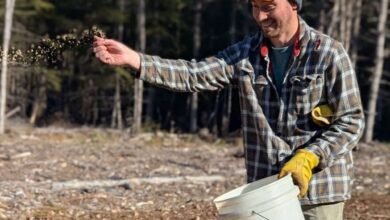
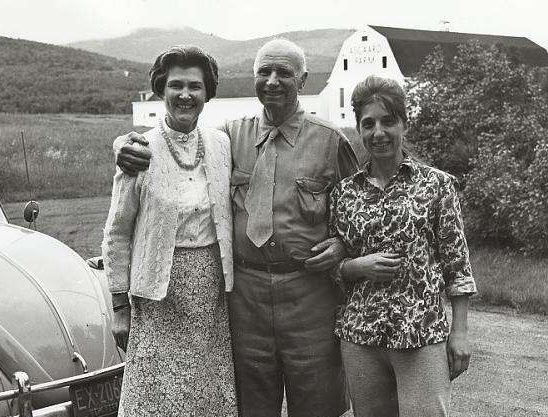
Illustrations, from above: Sally Kent Gorton, Rockwell Kent and Linda Champagne at Asgaard Farm, ca. 1960; Champagne (at top) works with volunteers (her children) cleaning up the area on the bank below the Niskayuna Train Station in August, 1977; and Champagne presents Arthur Crocker Lecture, at the Kelly Adirondack Center in June 2008.
Source link