 Log landings are small clearings created during forestry operations where timber is temporarily staged before transport. These sites are often heavily disturbed, with compacted soils and layers of bark, woodchips, and woody debris left behind after logging.
Earlier this year AdkAction, in partnership with the SUNY College of Environmental Science and Forestry (SUNY ESF) Ranger School, set out to explore a simple question: Could log landings, areas typically left to slowly regenerate on their own, become intentional habitats for native pollinators?
They started with the lowest-intervention, easiest approach they could think of, to see how far minimal effort would go. They began testing the idea in Wanakena with three plots, keeping site prep to a minimum and testing variables like ground preparation (hand-raking away wood debris) and natural soil conditions (sandy, compacted, etc.).
Many wildflower seeds they sowed in May such as milkweed, black-eyed susan, and coneflower require cold stratification, a freeze-thaw cycle that signals it is time to sprout. That means they won’t have substantial data until spring 2027.
In the meantime, they tested what difference more site prep would make at the Charles Lathrop Pack Demonstration Forest in Warrensburg, another satellite SUNY ESF property dedicated to teaching, research, and demonstration in sustainable forest management.
In Wanakena, they had raked away thick layers of wood chips and bark by hand to reach the soil underneath, which worked on a small scale but wouldn’t be practical across large sites.
At the Pack Forest, they used a tow-behind road rake. Pulled by a truck or ATV, this implement clears debris and can help grade the soil as well.
With the ground ready, they measured out two 50’ x 50’ test plots. Because Adirondack soils tend to be acidic, which can inhibit some plant growth, they made soil pH their main variable and applied a lime treatment to one of the plots.
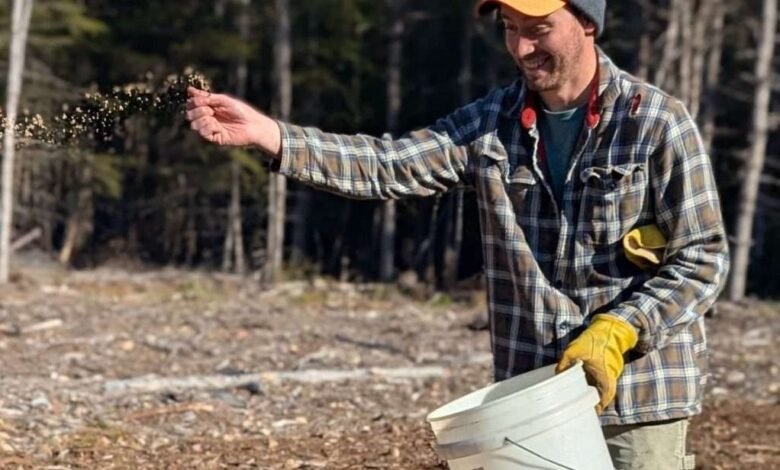
They spread a blend of their custom AdkAction Adirondack Pollinator Seed Mix, sand for distribution, and rye to serve as a nurse crop (a fast-growing cover that protects slower native seedlings).
After spreading a 50 pound bag of pulverized lime across Plot 1, they broadcast the seed mixture over both plots.
Comparing a low-intervention start with more intensive prep helped ask questions that matter to landowners, loggers, and foresters:
How little site prep can you get away with, and how much does additional prep improve results?
How can you make seed application and site prep as low-cost and low-labor as possible?
Which native plant species actually thrive in the compacted, carbon-rich, acidic soils common to log landings?
Can certain tools and implements make pollinator habitat restoration a standard, post-harvest practice across the Adirondacks?
For now, our work on the ground is complete. Now they await the long, cold North Country winter.
In the spring, they’ll return to Wanakena and Warrensburg to see which seeds take root, which plots bloom, and how site prep may have influenced growth.
You can follow progress on the project here.
Read More About Pollinators in New York
Photo: Sowing wildflower seeds for pollinators at a log landing (courtesy AdkAction).
Source link