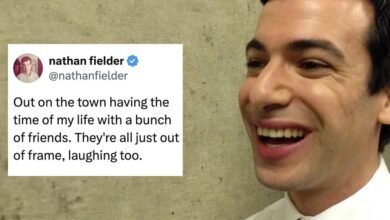


In its second half You Can See Everything is forced to switch gears as Elizabeth begins her prison sentence and access to her obviously becomes an issue. Two years go by; the film does not clarify why this time elapses before Fielder and Oppenheim resume shooting, but presumably it was because they didn’t have enough material and had to figure out how to finish the film. When Fielder returns to Texas, he discovers Billy has turned his incarcerated wife into something of an enterprise, proudly announcing he can speak for her. Fielder seems disturbed by this deprivation of liberties which extends beyond the physical one Elizabeth is experiencing. He recruits Amanda Seyfried – who previously portrayed Holmes on miniseries The Dropout – to assist him in a new endeavour: attempting to establish if Holmes is a victim of a controlling husband, or a master manipulator who’s worked out how to hide behind odious men to give herself plausible deniability.
It’s easy to see why You Can See Everything has become such a water cooler moment for pop culture; its juicy true crime subject matter and familiar reality television-adjacent interpersonal dynamics are appealing to a culture dominated by endless instalments of the Real Housewives franchise, dating shows with Love somewhere in the title and a game show in which people – sometimes famous, sometimes not – gleefully lie to each other for a large sum of money. Audiences love to speculate on the behaviour of strangers and indulge in some sofa psychoanalysis. (We see this even within the film; Holmes’ father offhandedly remarks everything changed for his daughter after she was raped with no further explanation, while Evans repeatedly refers to his wife as “weird”.) Fielder’s work has often blurred the lines between reality television and comedy performance; it seems only natural this extends to You Can See Everything. Likewise, his noted interest in stage magic seems pertinent: what is a successful magic trick if not an appealing lie?
The film that Fielder and Oppenheim have ultimately produced has much in common with Welles’ F for Fake, and it’s hard to image a world in which the two filmmakers haven’t seen that seminal work (or indeed Abbas Kiarostami’s Close-Up about a cinephile fraudster). You Can See Everything seems to be in dialogue with Welles’ film, using a compelling zeigeisty crime story in order to explore broader questions about human dynamics. Both Fielder and Oppenheim have form for this, and their collaboration feels like a natural extension of their own artistic interests while engaging audiences in a game of psychological chicken, daring us to blink before they do. The film’s title becomes a threat and a promise; the filmmakers are permitted unrestricted access to Holmes and Evans, but in the process, the apparatus of the work itself becomes visible. It’s not just the subjects who become trapped under the microscope, but Fielder too, as the film subtly reckons with his own career built on needling at the sort of self-delusion that seems non-negotiable to both a career in the arts and technology.
This isn’t to say You Can See Everything is a flawless act of filmmaking. A repeat viewing exposes the wire work, just as watching a magician closely enough reveals the sleight of hand, and questions arise as to what information is being omitted. It’s remarkable that the film still feels as impressive when you see the cogs turning; when you know what Fielder is about to do for his next trick. The recruitment of Seyfried (and her Testament of Ann Lee co-star Christopher Abbott) to stage re-enactments of unrecorded conversations with Holmes and Evans is what ties the film together and so clearly establishes it within Fielder’s larger body of work. Seyfried’s curiosity and emotional clarity provide a welcome contrast from the inscrutable Fielder; she lights up the screen and possesses a palpable charm and warmth that diffuse some of the tension that builds as Fielder grapples with the increasingly bizarre subject matter. She serves as a sort of audience surrogate, forthright in her assessments of Holmes and Evans, her reactions expressive and relatable. Crucially, her proximity to Nathan invites us to see him as an actor too, and in turn question his own place in the narrative. It’s easy to see what Holmes and Evans want out of this film. What about Fielder?
It’s a remarkably current documentary. In our uncertain present, increasingly we are exploited by liars who believe their own bullshit and we are encouraged to offload the very act of thinking to machines, in turn enabling a sort of plausible deniability that Holmes seems to rely on by deferring to her husband and protesting that she was a victim of deception herself in the Theranos debacle. The pandemic and prolonged periods of isolation irrevocably changed aspects of human behaviour, particularly in public and communal spaces. You Can See Everything becomes a statement of dramatic irony by the film’s end; we’re left to wonder, just as Fielder is, what exactly we’re missing. Is it even possible to truly know another human being? How can two things be true at the same time? To what extent does intention matter if a person is hurt all the same?
It’s too early to say if You Can See Everything will be looked back on as one of the defining films of the cultural moment, but it certainly feels like it, less a film about a strange, evidently manipulative pair of individuals and more a three-hour examination of the stories – the lies – we tell ourselves in order to live, and how we tell them to each other. In the process, Fielder and Oppenheim expose the arbitrary designation between fiction and non-fiction filmmaking, and by proxy a worrying inability within society to think critically about the media we consume. It is a film about communication between human beings; the odd, interesting, frustrating, funny and worrying ways in which we attempt to relate to one another, even after thousands of years of existence. In some ways this is a comforting thought: we are a constantly evolving species. In some ways, this is a worrying thought. We are always finding new ways to lie to one another.