
 This fall, the Franklin County Land Bank, which began as a volunteer-run organization in 2023, unveiled its first completed project, a new factory-built home that replaced a dilapidated property in Tupper Lake. Five more such projects are in the works.
That’s certainly good news for the prospective homeowners, whose decent jobs have not provided enough income to pay for a typical Adirondack starter home.
But it is also good news for the Adirondacks. Run-down properties that are restored to health boost property values of neighboring homes, pay taxes, make the community more attractive and discourage vandalism and crime.
People who have previously been priced out of the Adirondack housing market will put down roots and contribute to the community instead of having to move away.
“A lot of people just need a home,” Land Bank Executive Director Shiela Conners said of the people who have queried her about the program. “They’re paying so much rent for something that they can’t really afford and doesn’t belong to them.”
That’s what the land bank provides.
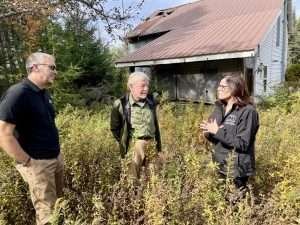
A typical project is just getting underway in Vermontville, where an unsightly house was rotting away, with a gaping hole in the roof used by firefighters to extinguish a blaze. The structure, which has been condemned, will be demolished and a new home put in its place.
Within a year, this blighted property will be gone, and in its place will be a simple but attractive home.
“Our three goals are, first, creating affordable workforce housing, second, improving neighborhoods by removing blight, and third, returning properties to the tax rolls,” said Harry Gordon, chairman of the land bank board.
“This is a blighted property that has been off the tax rolls for some time because the owners were foreclosed upon. So we’ll achieve all three of our goals with this project, and that’s really what we’re all about.”
Yet Sheila Conners, executive director of the Franklin County Land Bank, said land banks are still a new concept in the North Country and their constructs are sometimes misunderstood.
Some people are suspicious that the program is making someone rich at taxpayer expense, or that individual projects can’t make a dent in the tight housing market.
Instead, the land bank targets blighted homes that have been foreclosed upon or abandoned — those that the private housing market is unable to resurrect, and have ceased paying any taxes at all.
The land bank obtains these properties from the county by paying the back tax bill or the appraised value, whichever is higher. Some of these houses can be saved, some can’t.
Either way, the cost of rehabilitating an old house or replacing it with a new, factory-built home runs upwards of $400,000, more than twice what people earning average Adirondack salaries can afford.
That’s where the state land bank steps in, making up the gap between the cost of the home and what the prospective owner can afford to pay.
“That makes it affordable to people who are nurses and teachers and police officers and folks like that who might not otherwise be able to afford the housing and therefore maybe they can’t live here,” Gordon said.
“We’ve had teachers who turned down jobs because they couldn’t find places for their families to live. That’s not good for our community.”
 The properties will have deed restrictions that prevent anyone from buying a house and then reaping a windfall by flipping it on the open market. Nor are any contractors getting rich on the program.
The greater problem, Conners said, is finding contractors willing to work within the tight margins of the land-bank model.
And while rehabbing or replacing one house at a time can seem like spitting into the wind considering the Adirondacks’ severe housing problem, land banks are one piece of a multi-pronged initiative by state, regional and local organizations that are all contributing small numbers of workforce housing that, taken together, add up to meaningful change.
Nor is there any shortage of plenty of potential targets for rehabilitation or replacement. In the village of Malone alone, there are 78 properties that are abandoned or dilapidated, Conners said.
And while the state may help with the funding, the program is driven by officials who are locally elected, and can ask the land bank for help transforming an unsafe and unproductive piece of property.
“It’s typically going to be somebody’s first house and so it’s not going to be a fancy house, but it’s going to be a very livable house,” Gordon said.
“They will move in with their family, and maybe they’ll own it for five years and sell it because maybe they need more space for more kids. But this is a starting point. This is a way for them to start building equity and continue to move up and, we hope, stay in the county and contribute to the economy.”
Joe Shoemaker, a member of the Franklin County Legislature, said the Adirondack communities have multiple issues to address, but housing tops the list.
“If you’re going to get really serious and dive deep into helping our communities grow and thrive, you can’t have those conversations without talking about affordable housing,” he said. “Because if you look at the data, it is one of the biggest barriers we have, which is why I really appreciate what the land bank is doing.”
Read More About Housing in New York
This essay by Tim Rowland, a freelancer in Jay, NY, is provided by the Cloudsplitter Foundation of Saranac Lake and part of a series focusing on the missions, successes and struggles of North Country organizations, upon which people are increasingly dependent.
Illustrations, from above: Franklin County Legislator Joe Shoemaker, Franklin County Land Bank Chair Harry Gordon and Franklin County Land Bank Executive director Shiela Conners outside a land bank property in Vermontville (photo by Tim Rowland); and the Franklin County Land Bank’s first completed project in Tupper Lake (photo provided).
Source link