
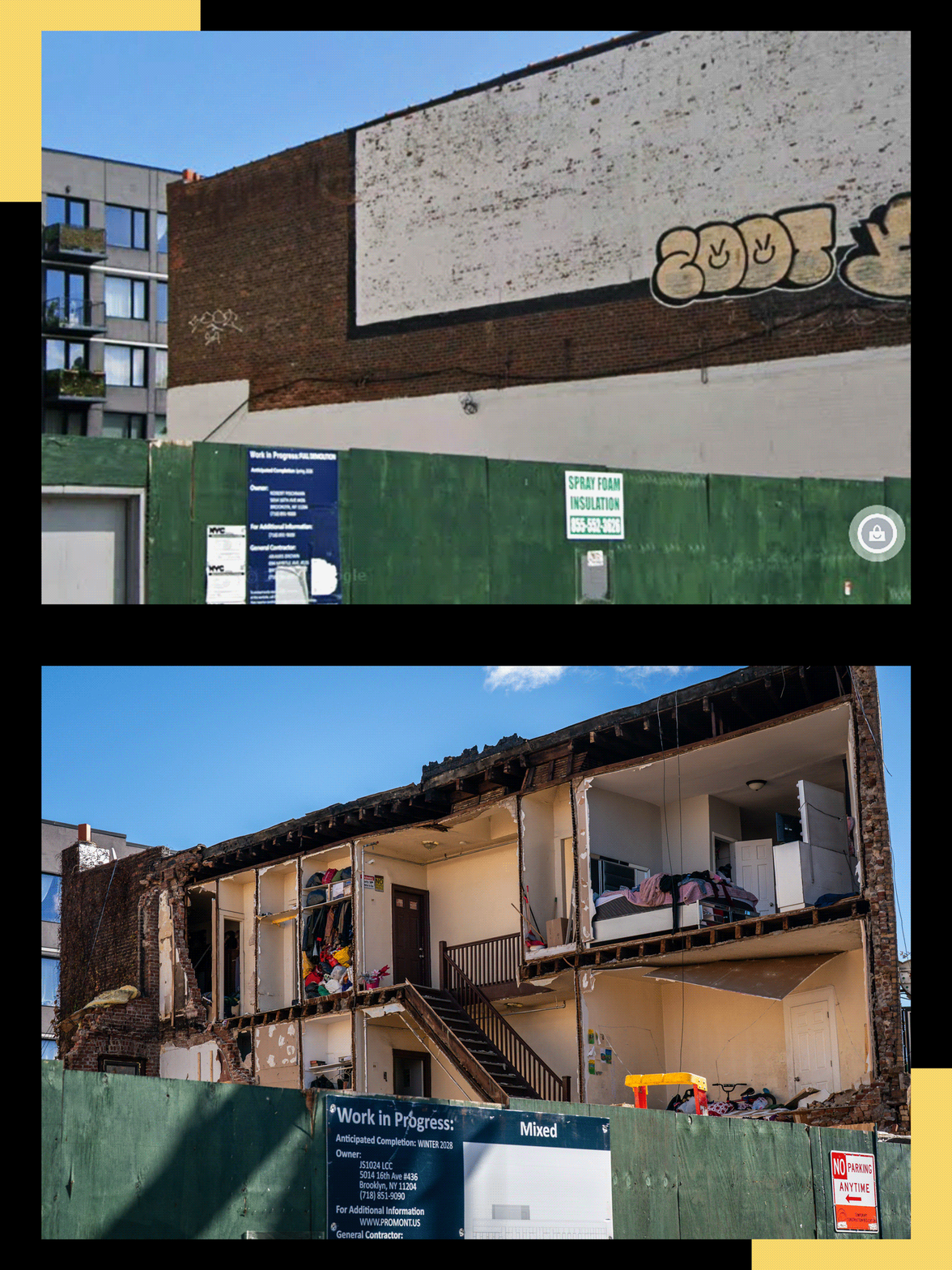
The demolition contractor at a site adjacent to a multifamily building that collapsed had racked up more than 300 penalties across the city before tragedy struck in Flatbush last week, including two prior violations at the 2625 Bedford Avenue site now covered in debris.
N Tech Design of America received 305 penalties across 139 job sites over four years, according to The Real Deal’s review of Office of Administrative Trials and Hearings records. Many remained open and unpaid as of Nov. 16. Two dozen sites had penalties issued for demolition-related infractions.
Required overhead protection for the neighboring properties wasn’t installed before demolition work began at 2625 Bedford Avenue, prompting the Department of Buildings to issue a $2,500 penalty and stop work order in March.
Upon returning to the site in April, a DOB inspector found that the demolition team had proceeded with tearing down the building at 2625 Bedford Avenue, violating the stop work order, which resulted in an additional $10,000 penalty, according to Office of Administrative Trials and Hearings data. N Tech paid both penalties in full and corrected the issue, and the stop-work order was lifted in May.
Seven months later, the neighboring multifamily building at 1321 Flatbush Avenue collapsed into the excavation site, killing eight people and injuring 18 others, including construction workers and children.
Owners Robert Fischman of W6 Facility X, along with Judy Swimer and Faigy Fischman, whose LLCs bought the property in 2024, enlisted N Tech to handle demolition. The development team also brought on Mordechai Waisbrod of Townhouse Builders to carry out shoring work, MD Islam of RI Consulting Services as special inspector and engineer Jieming Wang of LMW Engineering.
The owner of 1321 Flatbush, Olufemi Falade, had also racked up nearly 100 HPD violations at the building before it collapsed and dozens more HPD and DOB violations across his Brooklyn portfolio, serving jail time for past infractions in 2006. Inspection images taken prior to demolition of the adjacent one-story building show cracks in the facade on the north side of Falade’s multifamily building.
The disaster has prompted investigations by the Mamdani administration and Brooklyn District Attorney’s Office, as well as calls for accountability from neighbors, victims’ families and labor leaders. City officials are also examining more than 100 other sites associated with five entities involved in the Bedford Avenue project.
The cause of the collapse remains under investigation, including whether the excavation work adequately supported the neighboring building.
N Tech’s track record
N Tech raised red flags with the DOB before the collapse.
The contractor accumulated its highest number of violations at 599 Willoughby Avenue in Bedford-Stuyvesant, where permits were filed for a five-story residential development. N Tech’s 14 unpaid OATH penalties were imposed for demolition sequence and site safety violations, totaling $56,690 in fines. Other sites where the contractor has incurred DOB penalties range from a Flatbush Avenue assemblage one block away from the site of the collapse, to distant locations including Staten Island, the Bronx and Far Rockaway.
Andre Bergman, who lists N Tech on his LinkedIn and is associated with the phone number on the firm’s website, has half a dozen violations of his own. For one unpaid $10,000 penalty on a Queens job site where Bergman was superintendent, a DOB inspector reported a one-story structure at the demolition site collapsing onto the adjacent street, damaging multiple vehicles.
An N Tech spokesperson declined to comment.
The practice of incurring penalties and moving ahead with demolition, excavation or construction, even through a stop-work order, isn’t isolated to one contractor or job site given the high cost associated with stalled projects. Other contractors across New York City have built DOB penalties into their business model, opting to pay fines and clear violations rather than delay further, according to Steven Sladkus, founding partner at Schwartz Sladkus Reich Greenberg Atlas LLP, who doesn’t have ties to the job site or collapsed building.
“I absolutely have seen things like that,” Sladkus said. “It’s cheaper to just keep going … every day that ticks by costs money.”
Support structures
The ongoing DOB investigation is reviewing whether work at 2625 Bedford Avenue complied with approved plans.
Robert Fischman had received approval to develop a three-story building with eight units in March 2026, but the developer had also sought approval for a larger nine-story project with 64 units, a community space and grocery store, which DOB hadn’t granted before the collapse. Projects over seven stories require a site safety coordinator to oversee demolition and construction processes, which the Bedford Avenue site does not list in its DOB filings, The New York Times reported.
Engineer Wang’s plan for the site, approved by the Department of Buildings, called for bracing with steel buttresses around the perimeter of 2625 Bedford Avenue, except for the portion abutting the north facade of 1321 Flatbush Avenue. That portion used benching excavation, a standard industry practice that has been safely performed at other work sites across the city for decades, according to DOB spokesperson Andrew Rudansky.
“They did dig below the sidewalk and the adjacent buildings, and in a lot of those videos you can see piles, timber lagging and braces, all things you would typically see at a site like this,” Joe DiPompeo, founder of structural engineering firm Structural Workshop who wasn’t involved in the project, said. “If the supportive excavation failed, or was not installed in the right spots, or the procedures they were supposed to follow were not followed, this is exactly what you would expect to happen.”
Approved plans called for digging into the soil at a 45-degree angle to a depth of approximately 15 feet next to the rubble foundation of the multifamily building at 1321 Flatbush Avenue. The DOB is also reviewing the geotechnical report submitted by Michael Karantinidis of International Geotechnical/Structural Laboratories Inc., in which he noted that “deep underpinning, if planned, may also need lateral support of existing structures.”
Wang has eight past violations, including one for “failure to provide required notification prior to demolition” at a Bronx job site, which DOB paired with a $12,500 penalty in 2022 before dismissing the fine at a hearing. Another penalty paid by Wang in 2020 named “deficient underpinning support of adjacent properties on [support of excavation] drawings,” as its underlying violation. Wang didn’t respond to a request for comment.
Waisbrod of Townhouse Builders has at least 19 past violations from the DOB, including a $4,800 fine he paid in 2013 for demolition work without a permit and multiple construction safety violations. Townhouse didn’t respond to requests for comment.
“That shows just the disregard for following the rules in general,” DiPompeo said. “A lot of the evidence is going to be completely destroyed, between the debris pile, likely soil collapse into the hole. The [investigating] engineers are getting the last stab at this one because there were life safety issues, which obviously had to come first.”
Read more

NY Dirt: Trades urge reform after deadly building collapse

Collapsed Flatbush building, adjacent job site have history of violations

City plans 100-building inspection sweep after deadly building collapse