 On a hilltop outside of Elizabethtown, in Essex County, NY an idea is taking shape. It begins with the notion that there is art in everything, whether it’s throwing a pot, cooking a meal or working the land.
Then it uses those arts to enliven and enrich the local community, be it through a literary reading or an outside refrigerator stocked with free food for those in need.
It’s a broad message, one ill-adapted to elevator speeches. Many nonprofits have singular missions — they are focused on one square of the community, whereas at Craigardan the focus is the whole quilt.
Craigardan was founded as an artist residency in Keene in 2016 by Michele Drozd, and three years later it bought a heavily logged piece of land for an educational campus that’s currently under construction.
When completed it will have new living quarters, studios, kilns, kitchens, gallery, and event space.
In some respects, the scarred land was symbolic of many Adirondack communities that have suffered under economic models — including housing that’s unoccupied much of the year and seasonal employment — that generate short-term cash while diminishing long-term health.
 Craigardan is interested in mending both the land and the community while using the Adirondacks as an inspiring backdrop for creativity.
It attracts international-caliber artistic talent, where practitioners spend weeks perfecting their crafts while meeting other artists and engaging with the community.
“We have people coming from all over the U.S., people coming from all over the world — we’ve had artists from Australia and Dubai and all over Europe and Russia and South America,” Drozd said.
“And the neat thing is, they’re just as fascinated by the wonderful people who live here and work here and do amazing things here as we are with the work that they’re doing. So it really is a true exchange.”
Many are from urban areas, and when they hear their first yip of the coyote they might swallow hard — but many of these creators fall in love with the region, and some stay, helping fulfill the Adirondack need for new blood.
Drozd has a degree in fine arts, but experience in agriculture and architecture, so when she was offered land in Keene in 2015 to create an artist retreat, her vision didn’t stop with traditional artists and writers.
“What if we could welcome researchers, journalists, chefs, people who are thinking about the economy, people who are agriculturalists?” she said.
“I was curious about historic preservation and curious about science. And so I thought, wouldn’t it be great if we could bring all these diverse thinkers together into one space? And what if that space, instead of being a traditional artist colony, what if it was actually set on a working farm adjacent to the Adirondack wilderness?”
One last anomaly was that instead of sequestering its artists, Craigardan encouraged public involvement, allowing a cross-pollination of creative, global populations with small Adirondack communities.
It all seemed to be going well when the property owner in Keene decided to go a different direction and told Craigardan it couldn’t stay.
Rather than fold, the board chose to expand, and bought a spectacular mountain setting south of Elizabethtown — spectacular if you could overlook the deep log-skidder ruts, the ragged scrub left by loggers and eroded hillsides.
Craigardan began repairing the land by filling and seeding rutted lanes and turning them into hiking trails, and employing a handful of hogs which are particularly effective at regenerating the soil.
When their work is done and pastures take hold, sheep will be employed to do the mowing.
The capital projects have been made possible through more than $1 million in grants from the New York State Council on the Arts, and it pieces together its operating budget primarily from organizations and people who believe in its mission.
“I’m not a professional fundraiser,” Drozd said. “I have to fight for every dollar I get, through grants, donations and programming.”
She said the project has been appealing to the state because of Craigardan’s rural setting and the broad range of people it supports, regardless of age, skill level or what medium they’re working with.
 The campus is not within sight of the road, so most local people might currently identify Craigardan with the farm store, gardens and grazing sheep they can see on a 12-acre parcel alongside the highway.
Its hours are dependable, 9 am to 6 pm, Monday through Saturday.
On the porch is a refrigerator stocked with good food free for the taking, no questions.
“There’s no stigma,” Drozd said. “We’re trying to convince people that food access is a right, not a privilege. You deserve organic, wholesome food, so come and take it, it’s here for you. We’ll bring them into the garden with us, and we’ll cut them armfuls of whatever they want, and just send them home with it.”
Chickens will gobble up most anything that’s thrown to them, so people can bring their table scraps and trade them for eggs.
Stripped to its essentials, much of Craigardan is built around food and clay. Food is health, and it also greases the wheels of social interaction, which is particularly important in an environment where strangers come together.
Food is a conversation starter as artists discuss how it’s prepared in their particular corner of the world.
Clay is universal too; it can be fashioned into functional pottery or fine art, and working with it is therapeutic. “It speaks to everyone in different ways,” Drozd said.
“One of the unexpected findings was how magical clay is as a material in bringing people together. And also, having them then understand, from a much deeper perspective, their own work. So, for example, a lot of writers will come here and take free pottery classes with us, and all of a sudden, they’re changing the way they’re thinking about their book.”
This inspiration feeds the community, which is offered classes and talks and the opportunity just to see what this diversified group of artists is up to.
That interaction will ramp up with the opening of the new Mainhouse building to the public next May. “We want our local community and other nonprofits and other groups to feel like this campus is also here for them,” Drozd said.
“So if you want to have a meeting at the Mainhouse, or you want to come up and have your staff take a course — I want this to be a public space.”
And once there, the possibilities are boundless both for the residents from around the world and the local people from right here at home.
“Everyone is creative in their way,” Drozd said. “And some people will come here and say to me, ‘Wow, Craigardan gave me permission to call myself an artist.”
Read More About Arts in New York State
This essay by Tim Rowland, provided by the Cloudsplitter Foundation of Saranac Lake, is part of a series focusing on the missions, successes and struggles of North Country organizations, upon which people are increasingly dependent.
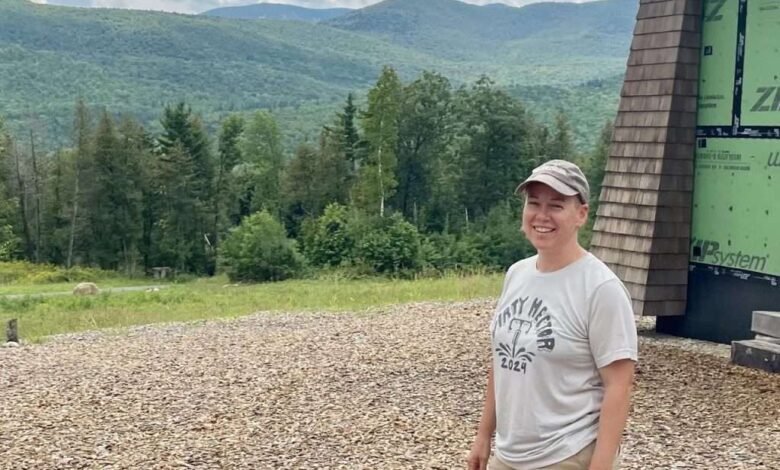
Photos, from above, courtesy Tim Rowland: The new complex at Craigardan south of Elizabethtown; Michele Drozd, executive director at Craigardan; and the kitchen pavilion at Craigardan.
Source link