 In 1894, during the second year of a four-year depression, the anger of working people gripped the nation. The economic downturn (the Panic of 1893) caused widespread bank failures, business closures, and high unemployment – up to 19% in some areas.
It was widely considered the worst economy in US history up to that time.
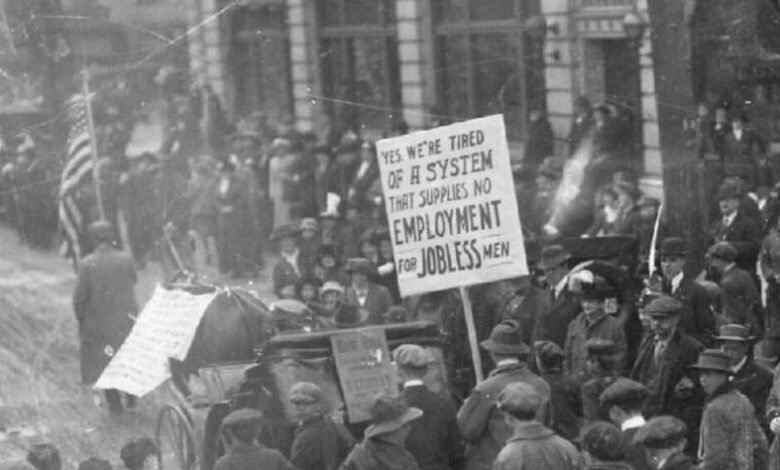
In March, unemployed people led by Jacob Coxey began a month-long march to Washington, DC. “Coxey’s Army” presented a petition demanding federal relief and public works programs to combat their suffering.
Then in May workers from the Pullman Palace Car Company struck over 25-30% wage cuts. Despite the cuts the Company refused to reduce company town rents or company store prices.
The resulting Pullman Strike was among the most consequential strikes in United States labor history.
The American Railway Union (ARU) led a nationwide strike and boycott. Clashes resulted in dozens of deaths, millions in property damage, and the arrest of socialist Eugene V. Debs, (and seven other ARU leaders) who served six months in prison.
Democratic President Grover Cleveland sent federal troops to break the strike, infuriating America’s laboring classes.
 The previous year Cleveland had led the repeal of the Sherman Silver Purchase Act, which alienated silver-backed farmers.
In August of 1894, he let the widely unpopular Wilson-Gorman Tariff Act become law by refusing to sign it, but not vetoing it.
(In 1884 Cleveland, a former Buffalo mayor and New York Governor who led the fiscally conservative, pro-business Bourbon Democrats, had been the first Democrat elected president after the Civil War, and after his loss to Benjamin Harrison four years later, and reelection in 1892, the first U.S. president to serve nonconsecutive terms.)
“During the Gilded Age of the late 19th century, there was significant economic growth, but much of it was fueled by high tariffs on imported goods,” writes long-time social studies teacher Greg Timmons.
“For half a decade prior, the grain market had suffered from overproduction, storms and then drought. In 1893, wheat prices plunged, and prices for several other agricultural commodities followed.
“The transportation industry was heavily dependent on the massive agricultural market, and when commodity prices crashed, it was only a matter of time before financially weaker railroad companies would fall.
“The first was the critically overextended Philadelphia and Reading Railroad. Twelve days before Cleveland was inaugurated, the declared bankruptcy. During the Panic of 1893, another 50 railroads would go under. Dozens of steel companies would collapse in their wake.”
Americans ran to banks to withdraw their money. European investors pulled their money from American stocks, helping crash the stock market.
 In the midterm elections in November 1894, the ruling Democratic Party (then still a largely conservative party) suffered the largest single-election turnover in American history.
The party’s 218-seat House majority was reduced to 93 (they lost 116 seats on election night, but it grew to 127 seats after a series of disputed results were finally settled). Today, the House has 435 seats, then it was 356.
In the Senate they lost their narrow majority, giving the Republican Party control of both chambers of Congress. The loss broke the Democratic coalition and set the stage for a political realignment ahead of the 1896 Presidential Election.
“Almost 90 percent of Northeastern and Midwestern House Democrats lost their reelection bids,” Timmons says. “The election had a long-term impact on the Democratic Party. Between the Civil War and the 1894 midterms, political power frequently shifted between the two parties.”
Timmons cites historian emeritus of the Senate Donald A. Ritchie. “Democrats won the popular vote in 1876 and 1888 while Republicans won the Electoral vote. Democrats often controlled the House while Republicans controlled the Senate. The Supreme Court was filled mostly by Republican presidents.”
 At the 1896 National Democratic Convention, Cleveland was replaced on the fifth ballot by the 36-year-old populist from Nebraska, William Jennings Bryan.
He went on to lose to William McKinley, who dominated the Electoral College 271 to 176. The popular vote was closer – 51% for McKinley; 46.7% for Bryan. McKinley was assassinated in Buffalo in 1901.
Republicans would continue to control both chambers of Congress for 14 years, but the demands of Coxey’s Army and the campaign of Bryan would have a lasting imprint on American history, despite Jacob Coxey’s arrest on their arrival for walking on the grass of the US Capitol, and William Jennings Bryan’s electoral loss.
The economic collapse of 1929 and the Great Depression finally shattered the 36-year conservative, pro-business political order established in 1896. In 1933, the Democrat’s New Deal finally implemented many of the populist ideas of 1896.
On May Day in 1944 Jacob Coxey was asked to return to Washington to read his original petition from the steps of the Capitol, helping solidify the idea that marches on Washington were an important mode of American protests.
Illustrations, from above: Coxey’s Army in Massillon, Ohio (courtesy of the Massillon Museum); anti-silver Grover Cleveland faces his political adversaries in a Puck cartoon, ca. 1894; a map of the Republican sweep in 1894; and William Jennings Bryan campaigns in 1896.
Source link