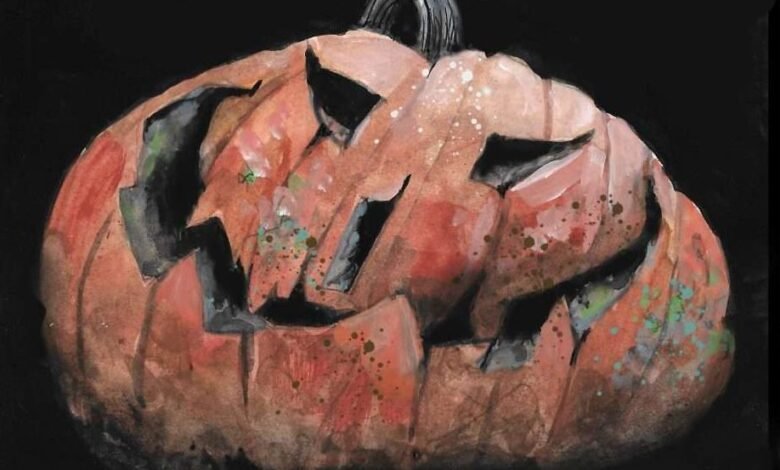
 Halloween is over, but the spookiest part of the year is yet to come. Soon, the jack-o-lantern on your doorstep will begin to droop and wither. Although you may recoil from the unwanted visitors that swarm, crawl, and ooze through its once-toothy grin, a rotting pumpkin actually highlights the most important players in autumn’s drama.
Decomposers shepherd our forests and gardens from summer lushness to winter austerity, returning nutrients to the soil and readying it for the rebirth of spring.
Decay begins as soon as the knife pierces the pumpkin’s gooey flesh. While you’re standing in the kitchen scooping out seeds to clean and roast later, air rushes in carrying a microscopic cargo of bacteria, yeasts, and fungal spores.
As oxygen flows over the exposed interior, oxidation reactions begin to occur, causing its bright color to fade as sensitive pigments break down, along with cell walls and other structures.
Combined with evaporation, this leads to a general sagging and puckering of the pumpkin’s once-sturdy shape.
Meanwhile, the end of a pumpkin’s life is the beginning of a whole new ecosystem. Lush carpets of growth unfurl their textures across the pumpkin’s interior.
Each of these biological cities is composed of a different organism, from bacteria to molds or slime molds, which are technically neither plants, animals, nor fungi.
Although it is hard to distinguish between species even with a trained eye, they harbor diverse functions that contribute to each colony’s particular microenvironment, the way New York City is known for pizza while Baltimore specializes in crab.
Actinomycetes, a class of bacteria found primarily in soil, which help break down tough, woody compounds – like pumpkin stems – produce the compound geosmin associated with fresh earth after rain.
Molds, meanwhile, are delicate spore-producing structures created by fungi, cousins to the mushrooms you might see on a walk. Unlike bacteria, their colonies represent a single multicellular organism that grows outward along its boundaries, guided by the tips of lacy hyphae that feel out new terrain.
In addition to this microscopic wonderland, insects and animals arrive seeking a nutritional windfall. As they consume the pumpkin, they help break it into smaller components, providing more surface area for decomposition.
Some creatures, like earthworms, millipedes, and woodlice (also known as pill bugs or roly-polies) feed directly on decaying plant material.
In contrast, flies visit in order to lay eggs, whose larvae hatch in an edible orange nursery. But even there, danger lurks: spiders spin their shimmery webs, lying in wait.
Although they may seem superfluous, the presence of these predators shows us that decomposition is not just a simple process, a factory conveyor belt of organic matter breakdown, but is instead a complex food web in its own right.
Left to its own devices, the pumpkin as we know it will disappear entirely, its matter having been recycled back into the soil. Unless it is thrown in a landfill.
There, unlike in a compost heap, the breakdown of organic matter happens in the absence of oxygen. Instead of earthworms, flies, and fungi, specialized bacteria called methanogens take over the process, producing both methane and carbon dioxide.
This process of decomposition is much slower, occurring naturally in places like peat bogs, where food and even human remains have been discovered, largely intact, after hundreds of years.
The decay of organic matter in landfills produces between 8 and 10 percent of the world’s global greenhouse gas emissions and results in sludge. Instead of nourishing the next generation of crops and spring growth, it is a highly toxic brew that must be managed and contained.
Our culture has instilled a fear of decay in most of us, using sanitization and artificial preservation in order to prevent the foretold end: rot, collapse, ruin. Yet no such story exists in nature.
The process of decomposition is a flourishing of its own that keeps the wheel of the seasons smoothly turning. Without decomposers, we would soon become buried under the staggering weight of our own waste: there would be no room or nutrients for new growth to appear.
Decomposers close the loop, keep the cycle from stagnating, and in their own way look to the future, showing us the possibilities that arise from letting go.
Maggie Weng is a writer and scientist currently working as a NASA postdoctoral fellow. Illustration by Adelaide Murphy Tyrol. The Outside Story is assigned and edited by Northern Woodlands magazine and sponsored by the Wellborn Ecology Fund of New Hampshire Charitable Foundation.
Source link