 At the time of the arrival of Europeans in the Hudson Valley, the Mohican had formed a loose alliance of tribal groups with as many as 40 villages, governed by sachems and advised by a council of clan leaders.
They had three clans: bear, wolf, and turtle. A general council of sachems met regularly at their capital at Schodack to decide important matters affecting the entire confederacy.
Warfare required a higher degree of organization. In times of conflict, the Mohican council passed its authority to a war chief chosen for his ability. For the duration of the conflict, he exercised almost dictatorial power.
Mohican villages usually consisted of 20 to 30 mid-sized longhouses, located on hills and heavily fortified (wigwams were used for smaller seasonal camps). Most of the Mohican diet was corn and other agricultural products, supplemented by game, fish, and wild foods.
For reasons of safety, the Mohican did not always move to scattered hunting camps during the winter like other Algonquian people, usually spending the colder months inside their “castles” (fortified villages).
Once they began trade with the Dutch, the Mohican abandoned many of their traditional weapons, becoming expert with their new firearms.
Iroquois – Mohican Conflict
The Haudenosaunee (Iroquois) organized into a confederacy of their own, an alliance of five tribes (Mohawk, Oneida, Onondaga, Cayuga, Seneca; later in about 1722, the Tuscarora became the sixth).
(Some Haudenosaunee scholars date the confederacy’s founding to August 31, 1142. Oral accounts describe a solar eclipse occurring when the Seneca agreed to join the alliance, which astronomers have matched to a total eclipse visible in the region on that date. Others place the formation much later, from 1450 to ca. 1600.)
The Mohawk (Kanienʼkehá꞉ka) referred to their northern Algonquian neighbors as ratirontaks, “bark-eaters.” While early nineteenth century historians believed a distinct tribe called the “Adirondacks” lived in the mountains and was driven out, others have argued that the Mohawk actually used the term for Algonquian bands living along the Ottawa River Valley in Canada, and the Adirondacks served primarily as shared seasonal hunting grounds.
 In the 1530s, French explorer Jacques Cartier encountered the St. Lawrence Iroquoians living in fortified villages like Stadacona (Quebec City) and Hochelaga (Montreal).
Cartier and his crew wintered near Stadacona, where over 50 local Iroquoians and 25 Frenchmen died. In the spring of 1536, Cartier betrayed the community by kidnapping Chief Donnacona, his two sons, and several others, taking them back to France from where none returned.
By the time Samuel de Champlain arrived in 1603–1608, those villages had gone, and the valley was contested hunting and trading territory among the Mohawk, Algonquin, Montagnais (now known as the Innu) and Maliseet (now known as the Wolastoqiyik).
Thus the St. Lawrence River west of Quebec City was a war zone blocking the expansion of the French fur trade to the west. Mohawk war parties made their enemies, including the Huron (Wendat), reluctant to bring their furs to Quebec. To win their loyalty, New France aided their efforts against the Iroquois.
 In July of 1609, Samuel de Champlain and at least two other Frenchmen accompanied a combined Algonquin, Montagnais and Huron war party south into New York. On Lake Champlain they encountered a large force of Mohawks. French firearms broke the Mohawk formation killing several of their number.
The fortunes of the Haudenosaunee turned at the beginning of Dutch trade on the Hudson River in the first decades of the 1600s. But in order for the Mohawk to trade with the Dutch, they first had to cross Mohican territory.
Relations between these two peoples had apparently been hostile for many years. One source of conflict was the Mohican had better access to tribes in the wampum shell producing areas of Long Island Sound, which gave them control of the trade in a valuable commodity.
The Arrival of the Dutch
Henry Hudson, originally employed by the Dutch East India Company to search for the passage to the east, changed course and ended up sailing up the Hudson River in September 1609, just two months after the incident on Lake Champlain.
The Indigenous People on the lower river proved hostile, possibly due to previous contact with European fishermen and slave traders, but Hudson continued upstream until he met shallow water near the Mohican village at Papscanee Island near the Overslaugh just below today’s Albany.
 The Mohican proved friendly and eager to trade. Hudson exhausted his trade goods and returned to Holland with a cargo of valuable furs, which attracted Dutch fur traders the following year to trade with the Mohican.
By 1613 the fur trade on the Hudson River had grown sufficiently lucrative. The next year Dutch traders mediated a truce between the Mohican and Mohawk to secure safe commerce. They then built Fort Nassau on Castle Island, located just south of present-day downtown Albany.
That same year (1614) the States-General of the Netherlands (Staten-Generaal) granted a charter to a consortium of thirteen Dutch merchants from Amsterdam and Hoorn (alongside their ship captains, including Adriaen Block and Hendrick Christiaensen).
It was called the New Netherland Company (Compagnie van Nieuw-Nederland) and it was granted a trade monopoly effective January 1, 1615.
In 1617, a severe spring flood damaged Fort Nassau just as fighting resumed between the Mohican and Mohawk. Because the fort was both flooded and dangerously close to the renewed conflict, the Dutch temporarily abandoned it.
Dutch traders were inclined to favor the Mohican, but they had also ingratiated themselves with the Mohawk by arming them against the Munsee and Susquehannock.
This gave the Dutch enough influence to negotiate another truce between the Mohawk and Mohican in 1618 and they rebuilt Fort Nassau on higher ground nearby.
Another flood destroyed the rebuilt post later that year, forcing its abandonment in favor of trading at what became known as “The Old Anchorage.”
The 1618 agreement gave the Mohawk unlimited access to the Dutch ships in the Hudson River below Albany, but required them to pay tribute to cross Mohican territory.
T his arrangement lasted for six years until 30 families under the direction of Cornelis May arrived from Holland in 1624. Most of these settled near the former Fort Nassau at a place which they called Maeykans, “Home of the Mohican,” and began to construct a new trading post (Fort Orange).
Coincidentally, after a decade and a half of supplying the Dutch with fur, both the Mohican and Iroquois had just about exhausted the beaver in their homelands.
In response, the traders at Fort Orange asked the Mohican to arrange trade with the Iroquois’ old enemies, the Algonquin and Montagnais in the St. Lawrence Valley.
Predictably, the Mohawk would not tolerate trade with their northern enemies. Resentful of paying tolls and eager to monopolize trade at the new fort, the Mohawk broke the peace in 1624, launching the four-year Mohawk–Mohican War (1624–1628).
This struggle led to the beginning of the decline of Mohican supremacy with the Dutch trade.
A version of this essay by Lauren R. Stevens first appeared as “A Brief History of the Hoosac Valley,” written for the Williamstown Historical Museum. It was edited and updated with contributions by John Warren.
The Williamstown Historical Museum is an admission-free museum and research center dedicated to explaining the history of the most northwestern township of Massachusetts. Founded in 1941 as the House of Local History, they preserve and promote knowledge of the Williamstown’s past. Their volunteer-run museum houses rotating exhibits, in addition to a research center with a substantial archive of photos, objects, and documents tracing the history of Williamstown.
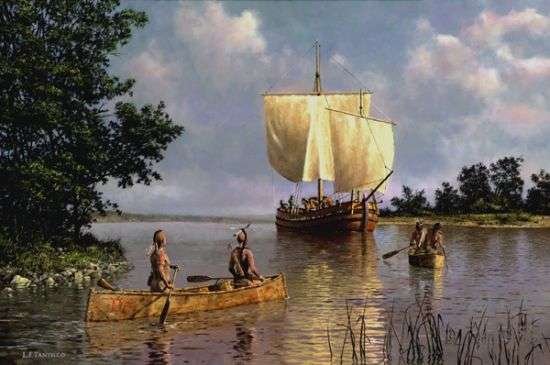
Illustrations, from above: “Pap-scan-ee,” Mohican encampment on the Hudson River, ca. 1600 (courtesy the artist Len F. Tantillo); Jacques Cartier at the Iroquois village of Hochelaga (present-day Montreal) in 1535, print from ca. 1850; A very general map of Indigenous peoples before European arrival; Tantillo’s “Curiousity of the Magua,” showing Mohawk approaching a Dutch trading vessel; and Tantillo’s “Fort Orange, 1635.”
Source link