 New York’s 127 miles of coastline make it the state with the 14th longest coastline. Protecting the coastlines has been considered an essential defense since at least the War of 1812, when New York Harbor was fortified.
Fortifying the harbor was accelerated after the June 1807 Chesapeake–Leopard Affair, a naval engagement that occurred on June 22, 1807, off the coast of Norfolk, Virginia, between the British fourth-rate warship HMS Leopard and the American frigate USS Chesapeake
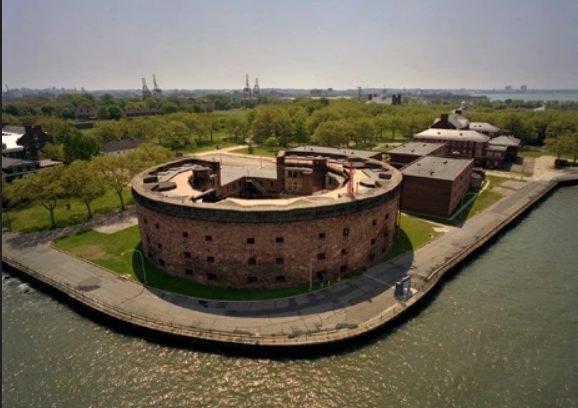
Among the installations developed during this period was Castle Williams (Governors Island), the first US first multi-tiered circular stone/masonry fort, mounting 78 guns; Fort Columbus / Fort Jay (Governors Island), rebuilt with granite and brick starting in 1806, mounting 60 guns; the South Battery (Governors Island), constructed in 1812 to protect the Buttermilk Channel; and the Southwest Battery (Manhattan Island), later known as Castle Clinton.
Various outer defenses, including Fort Richmond, Fort Morton, and Fort Hudson on Signal Hill (Fort Wadsworth), Fort Diamond (Fort Lafayette) in the Narrows, Fort Smith at Prince’s Bay, and northern Manhattan outposts like Blockhouse No. 1 built in 1814.
During World War I and World War II, New York Harbor was managed and defended by the United States Army Coast Artillery Corps under the unified command of the Harbor Defenses of New York (headquartered at Fort Hamilton and Fort Jay).
Rather than classic stone-walled forts, defense shifted to modern heavy artillery, anti-aircraft batteries, and digital/radar fire control.
Major installations like Fort Hamilton (Brooklyn), Fort Wadsworth (Staten Island), Fort Hancock (Sandy Hook, NJ), and Fort H.G. Wright (Fishers Island) acted as primary staging and training grounds.
Coastal defenses were upgraded by installing massive 16-inch gun batteries (such as Battery 116 at the Highlands Military Reservation and batteries at Fort Tilden in Queens). These were encased in heavy concrete bunkers and camouflaged with sand and vegetation to survive aerial bombing.
Upcoming Virtual Event
Retired Colonel Richard Comstock will present a unique virtual program, “Protecting the Coast,” focused on New York’s coastal defenses during the First and Second World Wars on Tuesday, November 17th at 12:30 pm. The event is presented by New York Archives magazine.
Registration is available here. A recording will be available afterward and will be emailed to registrants.
Read More About New York Military History
Illustration: Castle Williams on Governors Island (NPS Photo).
Source link