 Founded in 1812 in Worcester, Massachusetts, the American Antiquarian Society is a national research library of early American history that holds a fine collection of documents from the establishment of the nation’s first print shop in 1638 through to the year 1820.
One of its exhibits is a Dutch-style printing press referred to as “Old Number One.” This physical object tells a string of stories.
The historical press recounts the tale of a child apprentice in a printer’s office who developed a life-long affection for the “magic” mechanism, becoming the nation’s outstanding early printer and publisher.
It is also a reminder how Gutenberg’s invention of movable type accelerated literacy and contributed to the Reformation with all its consequences. It accounts for the vital role the press played in forging resistance against British rule.
Precious Cargo
During the early seventeenth century printing expanded into global communication when Amsterdam printers began producing news sheets. The oldest surviving sample dates from June 14, 1618, entitled Courante uyt Italien, Duytslandt, &c. (News from Italy, Germany, etc.).
During the 1620s several multilingual “courantoes” were issued in the city and spread to various locations, including England. For some time, news “out of Holland” was a chief source of (political) information.
To reach a growing audience, speed and scale of production were essential, driving attempts to improve the equipment. Launched around 1620 by the Amsterdam publisher Willem Janszoon Blaeu, the Dutch hand press featured a wooden lever mechanism and screw layout that sped up the process.
It became Europe’s main printing tool (the common press) until the invention of the iron press at the end of the eighteenth century.
America’s first press was a Dutch-styled mechanism brought over by Jose Glover, a non-conformist clergyman, and his wife Elizabeth. Whilst serving as Rector of the St Nicholas Church in Sutton, Surrey, he changed loyalty towards Puritanism.
In 1636, he left the church, planning to settle in New England and become a publisher. The sale of properties he owned in Kent financed the project. Having bought a printing press with the support of Dutch friends, he hired Sutton-born locksmith Stephen Daye to run the machine.
 In the summer of 1638, the John of London captained by George Lamberton, sailed from Hull to Boston. Amongst the passengers were the Glover and Daye families. Stowed away in the ship’s hold were a printing press, type, ink, and reams of paper.
Jose died during the crossing and was buried at sea, leaving Elizabeth the sole owner of the press and Stephen Daye’s indenture. They set up shop in Cambridge, MA, to produce the Bay Psalm Book, America’s first printed book (1640).
Kentish Migration
Eager to spread their message and ideology, English separatists were prolific pamphleteers. Puritans, Anabaptists, Familists, Quakers, and other groups also resorted to the printing press to advance their religious brands.
Their onslaught against the “half” reformed Church of England was met with brutal counterattacks. Authors, printers, and booksellers were imprisoned, physically attacked, or worse.
Once censorship made publishing too dangerous, radicals turned to printers in the Low Countries and continued their crusade by smuggling clandestine literature into the country.
When the “Great Migration” started in 1620 with the establishment of the Plymouth Plantation, they transported skills, practices, and tools from England to Massachusetts.
During the 1630s Archbishop William Laud, acting on behalf of King Charles I, had instigated the persecution of Puritans and separatists. Kent was a hotspot of dissent, and many families escaped from there across the Atlantic to “breathe God’s air of freedom in the fullest measure.”
In March 1635, the vessel Hercules sailed from Sandwich, Kent, to New England carrying 102 passengers, many of whom hailed from local towns and villages. The group included skilled workers, merchants, and clergymen. Most of them moved in family units. Printing arrived in America via Kent.
A tanner by trade, George Fowle was one of those emigrants. Having left England with his Norfolk-born wife Mary Tufts and their children, they arrived in Massachusetts around 1638 (the name of their ship is not known), initially settling in Concord, before moving to Charlestown where George operated his tannery and acquired land.
The couple’s descendants continued the family line in Massachusetts during the British colonial period.
Zechariah Fowle & Isaiah Thomas
Printers in Europe stood in the vanguard of radical change, both politically and culturally. They sparked the French Revolution by spreading Enlightenment ideas and enhancing sociopolitical awareness. The number of newspapers mushroomed.
Participants fought the battle for social transformation in print. The same applies to the American Revolution. Printers issued weeklies, broadsides, and pamphlets to spread news, promote the patriotic cause, and stir revolt against British rule.
Printer Zechariah Fowle was born in 1723/4 in Charlestown and learned his trade in Boston under his brother Daniel, founder of The New Hampshire Gazette. His modest business depended on a single Blaeu-style screw press built in London in 1747.
 In 1756, Fowle took on a child apprentice by the name of Isaiah Thomas. Seven years of age, his widowed mother suffered financial hardship and could no longer support her son. For Isaiah it was the beginning of a lifelong working relationship with his master’s printing press.
Isaiah’s great-great-grandfather Evan Thomas had moved away from his native Wales, lived in the County of Kent, before embarking on the William and Francis and arrive in Boston in June 1632.
He eventually settled as a vintner in the Massachusetts Bay Colony. Isaiah inherited an independent spiritual tradition rooted in his Welsh American heritage.
Having turned sixteen in 1765, he ran away from Boston although still legally bound to Zechariah. Thomas took refuge in Halifax, Nova Scotia, where he was employed by Anthony Henry (Anton Heinrich: a German immigrant who has served with the British forces), the town’s only printer and owner of the Halifax Gazette, Canada’s first newspaper.
Well-trained, Thomas soon acted as the de facto manager of the paper, but Henry was under pressure to sack his young employee for his fierce anti-British views.
In the spring of 1770 Thomas was back in Boston and reunited with Fowle. Having formed a partnership, they launched the Massachusetts Spy, a Patriot newspaper designed to challenge the journalistic status quo. Its first issue appeared on July 17, 1770, but cooperation was short-lived.
Thomas took full share of the company, thereby getting ownership of his childhood Dutch press and its type. He nicknamed it “Old Number One” and kept it throughout his life.
He turned the Spy into a voice for Patriot rebellion. While rival newspapers had circulations of a few hundred copies at best, the Spy reached 3,500 subscribers across the Thirteen Colonies.
Sedition Foundry
Between 1771 and 1775, Thomas worked from the second floor of a building at 41 Union Street in Boston’s oldest commercial district. Friends and associates feared that the British might confiscate his press. They urged him to remove it from the city.
 On the evening of April 16, 1775, with the help of figures like John Hancock and Joseph Warren, he crossed the Charles River and smuggled his press to the Whig stronghold of Worcester. It was reassembled in the basement of Timothy Bigelow’s house. The latter was a blacksmith and Patriot who rose from leader of local minutemen to Commander the 15th Massachusetts Regiment.
Four days later, Thomas traveled to Lexington to watch hostilities unfold. Using his “Old Number One,” he printed the historic May 3, 1775, issue of the Spy, featuring his eyewitness account of the outbreak of Revolution. He was one of America’s earliest war correspondents.
Thomas continued printing the Spy on his press, rousing Americans throughout the Colonies to seek independence. His printing shop was labeled a “sedition foundry,” and he was often in trouble with the Massachusetts Royal government.
Not surprising for a man who had the audacity to call British Parliament the most “sanguinary and despotic court that ever disgraced a free country.” He incited his readers with a slogan that would become a battle cry, “Americans! – Liberty or Death! – Join or Die!”
Rattlesnake
On May 9, 1754, The Pennsylvania Gazette published a cartoon showing a severed rattlesnake in the shape of a colonial map with the caption “Join, or Die.” Its engraver has not been identified, but the paper’s owner and editor Benjamin Franklin explained the significance of the “Emblem.”
 At the time, scientists had become intrigued by the venomous reptile. Early researchers mixed empirical observation with lingering folklore. The myth of the “joint snake” persisted, suggesting that reptiles regenerate their bodies after being severed.
The Gazette’s snake cartoon consisted of eight pieces, each of them standing for a part of colonial North America. Under existential threat during the French and Indian War, Benjamin Franklin called for the colonies to unite in battle or face defeat.
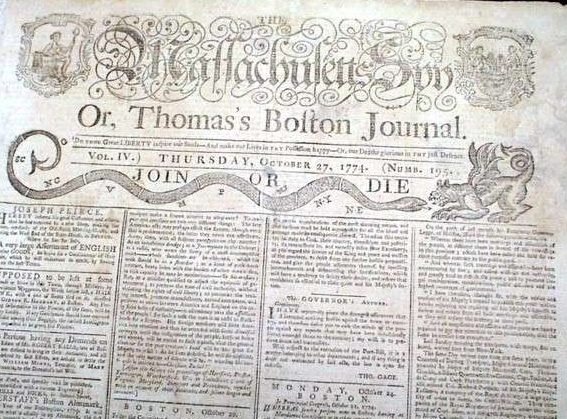
In July 1774, silversmith and Patriot Paul Revere engraved a variation of the iconic design and placed it into the masthead of Isaiah’s newspaper, repeating the phrase “Join, or Die.”
Some versions of the paper depicted the reconnected snake defending itself against a British dragon. The rattlesnake turned into a mascot, becoming emblematic of colonial pride and vigilance.
Trailblazer & Nation Builder
After the American Revolution, Thomas oversaw an extensive publishing and bookselling network across multiple states and set up a paper mill in Worcester in 1793 to combat post-war shortages. He understood that Revolution was not a one-off occasion but an ongoing process, the story of which had to be preserved. He made it his mission to shape an American identity.
Publishing music at the time was a slow and costly undertaking. To produce a song book, printers used engraved copper plates that needed the care of skilled artisans. Modifying notations or correcting errors was a tedious process. To a publisher with Welsh ancestry that
was an unacceptable situation.
On December 23, 1784, Thomas announced in the Spy that he had obtained a font of movable music type from the London shop of Joseph Fry & Son, enabling him to print music neatly and speedily. Two years later, he published The Worcester Collection of Sacred Harmony.
 The availability of this collection inspired communal singing in churches, schools, gatherings. Sing, share, and connect – music forged a feeling of unity. The creation of an “American sound” by composers like Oliver Holden or William Billings contributed to communal pride. Early in Isaiah’s career printing had been a tool of political rebellion; now it was a means of cultural congregation.
His 1791 Bible served a similar purpose. A landmark publication, it was the first illustrated folio Bible (King James Version with up to fifty-five copperplate engravings) printed in the United States.
Thomas was also the foremost producer of juvenile literature. In 1788, he produced A Curious Hieroglypick Bible, a novelty form that combined text with woodcuts to grasp children’s attention and encourage reading skills.
That same year, he printed The Royal Standard English Dictionary, compiled in 1775 by Scottish lexicographer William Perry. The work had helped to regularize pronunciation in Britain.
Linguistic unification was Isaiah’s main motivation for republishing this, the first dictionary issued in America. Driven by a passion to preserve all records of the young nation’s progress, he penned The History of Printing in America (1810), a groundbreaking two-volume study of the colonial press.
Thomas published hundreds of titles, including Boston-born William Hill Brown’s The Power of Sympathy, a tragic epistolary tale of seduction and incest based on a local family scandal.
Issued in January 1789, literary critics have labeled it America’s first novel. The risqué topic did not put him off. Like any competitive publisher, he was keenly aware of both popular interest and sale figures. Sound economics went with his sense of mission.
On October 24, 1812, Isaiah founded the American Antiquarian Society, donating about 8,000 books from his personal library. Thomas may not have been one of the political Founding Fathers, but he was a trailblazer whose “Old Number One” press laid the ideological foundation for the Revolution and built its cultural superstructure in the aftermath.
Illustrations, from above: Membership Certificate of American Antiquarian Society, signed by Isaiah Thomas (American Antiquarian Society); the title page of the Bay Psalm Book, 1640 (Beinecke Rare Book & Manuscript Library); the restored “Old Number One” printing press at the American Antiquarian Society; Ethan Allen Greenwood’s portrait of Isaiah Thomas, 1818 (American Antiquarian Society); Paul Revere’s segmented snake engraving “Join or Die” in the Massachusetts’s Spy, October 27, 1774; Revere’s engraved bookplate for Isaiah Thomas, ca. 1798.
Source link