Military stigmas and cultural stereotypes can hinder early intervention in service members experiencing gambling problems. That’s according to new research from the Kindbridge Research Institute’s Financial Stability and Responsible Gaming Initiative (FSRG) and Stigma Stand Down (SSD).
Today (Nov. 11) is Veterans Day, an annual observance honoring all living and deceased military members who served in the United States Armed Forces. A growing worry among active-duty and former military members is how the proliferation of gambling and sports betting is impacting troops.
Unlike many addictions, gambling problems often develop silently, emerging only when a crisis hits. For those serving in the military, behavioral health experts believe the culture can suppress early detection and intervention, precisely when support would be most effective.
We need to recognize the warning signs of gambling-related financial harm earlier, while also addressing the stigma and career concerns that can keep service members and veterans from seeking help,” said Dishi Umfleet, executive director of the Kindbridge Research Institute.
The report, titled Gambling-Related Financial Harm in Military Communities, found that military personnel are at heightened risk of developing gambling disorders. That’s because the six military forces skew young and mostly male, demographics most susceptible to concerning gambling behavior.
Military service is associated with elevated stress, trauma exposure, frequent relocation, and extended periods away from family. Combined with a culture described in the study as “competitive by design,” researchers deduced that many service members are willing to take on gambling risks that non-military individuals would avoid.
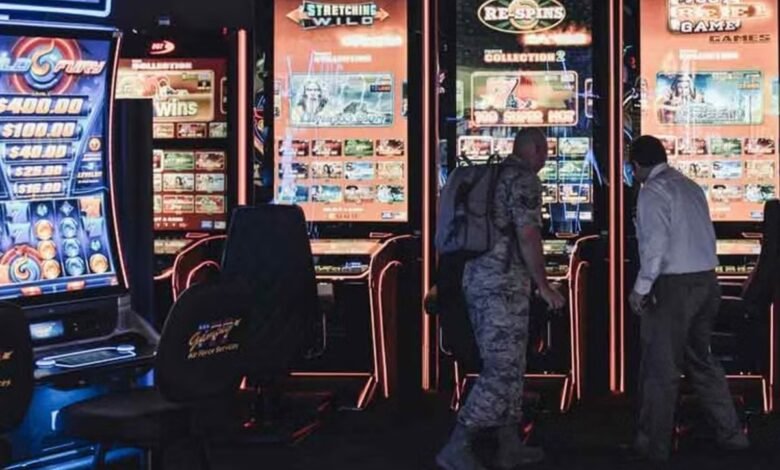
The Department of Defense (DoD) houses an estimated 3,000 slot machines on overseas military bases. The federal government is estimated to make over $100 million a year on the gambling devices. The DoD claims the money is reinvested to raise “morale, welfare, and recreation.”
Study Recommendations
The FSRG and SSD teams advise the U.S. military to integrate resources for problem gambling that better provide education, research, outreach, and treatment access. The goal, the study explained, should be to reduce stigma, expand services, and protect anonymity.
The brief suggests that the Armed Forces partner with a third-party nonprofit to offer anonymous self-check and telehealth services for problem gambling concerns. Unit commands should also be trained to detect problem gambling and communicate with their troops that help-seeking for gambling is a “readiness issue rather than a disciplinary one.”
Military counselors and clinicians should additionally inquire about a service member’s gambling during annual and routine screenings, the study advised.
Pete Hegseth Toughens Military
Defense Secretary Pete Hegseth has used his tenure to end the “woke” culture that he says was embraced by his predecessors.
The era of politically correct, overly sensitive, don’t-hurt-anyone’s-feelings leadership ends right now,” Hegseth said at a gathering at the Marine Corps Base Quantico in Virginia in September 2025. “You might say we’re ending the war on warriors.”
Hegseth, who goes by the secretary of war, added that the previous administration put “complainers,
ideologues, and poor performers in the driver’s seat.”
Source link