
The building trades joined families mourning the loss of eight people who died in a Flatbush building collapse to demand better safety measures and justice for victims.
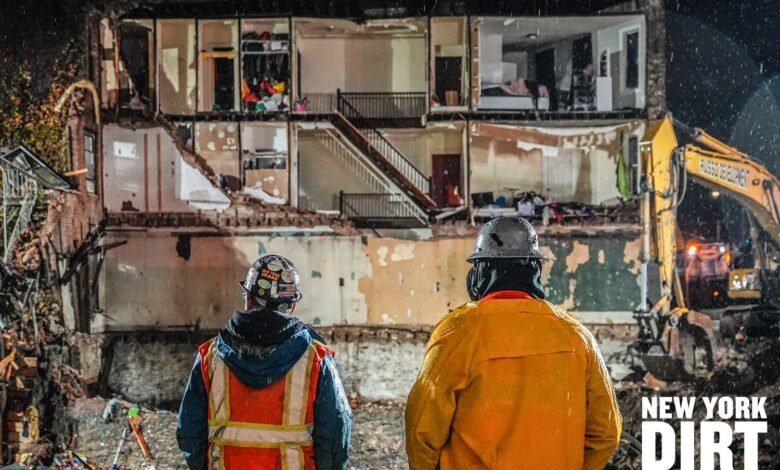
Three construction workers were identified among those who died after a multifamily building at 1321 Flatbush Avenue collapsed into the neighboring job site at 2625 Bedford Avenue. Two men from Guinea also lost their lives on Wednesday, along with a man from Colombia, his 9-year-old daughter and her 10-year-old cousin.
José Luis Caguana, Edgar Santiago Sapón Gutiérrez and Gabriel Siguencia were all working on the construction site at 2625 Bedford Avenue when the building fell. Caguana, 26, was the father of a four-year-old, with his wife expecting a newborn later this month. Siguencia, 22, had recently found work as a carpenter on the site after moving to New York last year. Both had come from Ecuador. Gutierrez, 26, was father to a six-year-old and moved to New York three years ago from Guatemala, the New York Times reported.
The project’s demolition contractor N Tech Design of America had been penalized earlier this year for lacking overhead protection and disregarding a stop-work order to demolish a one-story building in violation of Department of Buildings instructions.
The collapsed building at 1321 Flatbush Avenue has a track record of HPD violations and lien sales, with its owner spending time in jail for infractions across his Brooklyn portfolio. Inspection images before work began showed a crack on the multifamily building’s facade adjacent to the job site.
Excavation plans approved by the city didn’t require construction crews to install additional bracing to support the adjacent Flatbush Avenue building that fell, according to three structural engineers who reviewed the documents, Gothamist reported. Every other building around the perimeter of the construction site was required to have reinforcing steel buttresses, except the side abutting 1321 Flatbush Avenue, which called for cutting into the soil at a 45-degree angle to a depth of approximately 15 feet, excavation plans show.
At least 18 others were injured as a result of the collapse on Wednesday, including more workers from the job site at 2625 Bedford Avenue and firefighters who responded at the scene.
“That’s why we are here today, not only in solidarity, but also demanding the authorities, the city officials to do more to protect our workers, our people, our residents, regardless of their immigration status,” electrician Winston Sanchez, also from Ecuador, said at a press conference. “Developers, real estate, different construction companies, they’re making a lot of money with the blood of many construction workers.”
The Mamdani administration launched a sweep of 100 other properties where five entities the city identified as active at 2625 Bedford Avenue are currently involved in projects. DOB and the Brooklyn District Attorney’s Office are investigating the cause of the collapse, with rescue efforts concluded at the site. DA Eric Gonzalez has opened a criminal inquiry into the collapse.
A state law named for Carlos Moncayo, another Ecuadorean construction worker who died on a job site in 2015, increased criminal liability and brought financial penalties up to $500,000 when an employee is seriously injured or killed due to negligence or recklessness. Moncayo’s family received just $10,000 from Harco Construction for manslaughter after he was crushed in a trench collapse near the High Line.
“Worker safety is public safety,” Gary LaBarbera, president of the Building and Construction Trades Council of Greater New York, said in a statement. “Although the investigation into this particular incident is ongoing, it should be emphasized that implementation and adequately funded agency enforcement of safety standards on construction sites and connected buildings must be of the utmost priority, not only for the sake of the workers on the job, but also for the surrounding community that could be directly affected by any accidents or failures that occur.”
What we’re thinking about: Did DOB’s sweep of office-to-residential conversions following the partial collapse of the former Pfizer building inspire confidence? How can the agency show New Yorkers that job site conditions are safe for construction workers and neighboring residents? Let me know what you think at ben.miller@therealdeal.com.
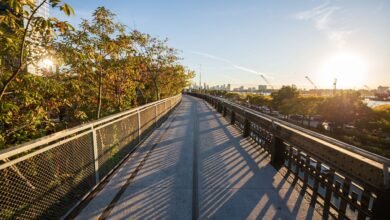
A thing we’ve learned: The Holland Tunnel opened to the public 99 years ago, linking New York and New Jersey beneath the Hudson River with the world’s first mechanically ventilated underwater tunnel for vehicles. The four ventilation towers, two on each side of the river, were designed by architect Erling Owre and engineered to hold massive fans that completely exchange the entire volume of air in the tunnel every 90 seconds.
Elsewhere…
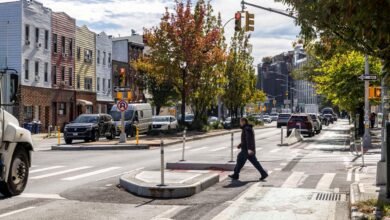
— Mayor Mamdani unveiled the long-awaited redesign of McGuinness Boulevard in Greenpoint on Friday, adding protected bike lanes and shorter pedestrian crossings, according to The City Reporter. The thoroughfare had played a pivotal role in an Adams administration bribery case involving top aide Ingrid Lewis-Martin, who was criminally charged for a scheme to influence City Hall. The owners of film production company Broadway Stages allegedly gave Lewis-Martin cash, catering and a cameo in “Godfather of Harlem,” filmed at their Greenpoint soundstages, in exchange for stopping a previous redesign introduced by former Mayor Bill de Blasio.
— The mayor also secured a 90-day extension for small businesses nationwide, including New York City’s bodegas, to comply with new Supplemental Nutrition Assistance Program rules after striking a deal with President Donald Trump, amNY reported. Several small businesses were at risk of losing their ability to accept SNAP, with enforcement now delayed for at least 90 days, giving them more time to adjust inventories to meet stricter federal standards.
— State Sen. Julia Salazar, who is angling for the role of the state legislative body’s next housing chair, plans to tackle high insurance costs for developers and operators, address vacant rent-stabilized units and revisit 485x, Politico Pro reported. Ideological opponents to the DSA lawmaker have increasingly praised her pragmatism, with some preferring her for the role of Senate housing chair over State Sen. Liz Krueger.
Closing time
Residential: The most expensive residential sale recorded Friday was $8.5 million for 255 East 77th Street, 26B. The Upper East Side condo is 2,900 square feet. Compass’ Alexa Lambert, Alison Black and Shelton Smith had the listing.
Commercial: The most expensive commercial transaction recorded was $142.5 million for 360 West 43rd Street. The Hell’s Kitchen mixed-use building is 23 stories, 250,000 square feet and includes 256 units. The Brodsky Organization sold the building to Atlas Capital Group, per records.
New to the Market: The highest price for a residential property hitting the market is $24 million for 175 East 82nd Street, Unit PH4. The Upper East Side penthouse is 4,700 square feet and new construction. Brown Harris Stevens’ Young New Development Group has the listing.
— Joseph Jungermann