 In the mid-1840s, an iron mortar bomb that had recently been recovered from the shallows of Lake George nearly nine decades after it had been first fired during the French & Indian War (1755–1763), finally exploded.
On August 15, 1866, a central New York state newspaper published a retrospective news story about the event that occurred “some twenty years” earlier. According to that article in the Madison Observer (Morrisville, New York), in the mid-1840s the colonial-era ordnance had just been discovered in the waterway below where Fort William Henry (1755–1757) once stood.
The artifact found underwater near shore was an unexploded mortar bomb discharged by French artillery soldiers during their August 1757 siege of British-held Fort William Henry.
 In early August 1757, the French soldiers, with support from their Indigenous allies, initiated a cannon, howitzer, and mortar bombardment upon British-held Fort William Henry. For several days, the French dug trenches to move their heaviest guns – mortars and howitzers – close enough to accurately lob deadly salvos into the fortification.
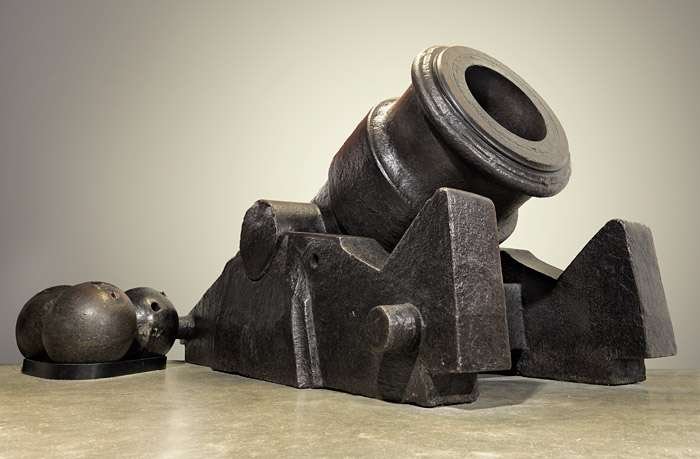
The heavy shell that was found in the mid-1840s was a circular hollow ball, probably about nine inches in diameter, and with a hole that held a fuse. The old bomb was packed with black powder.
French gunnery troops shot the explosive by first lighting the fuse in the iron ball and then touching off the mortar. That propelled the projectile in a high trajectory toward its target.
The artillery troops’ goal in August 1757 was to fire the projectile with its fuse burning, hoping the artillery ball would detonate while airborne, raining down deadly shrapnel upon the British inside their garrison.
In this case, the 1757 fuse was probably too long or while mid-air the fuse snuffed out. The intact mortar bomb fell short of the fort and into the lake without fragmenting.
The relic’s discoverers in the 1840s decided to test the artillery ballistic. Foolhardily, they lit the armament’s fuse and scampered to cover. Somewhat to their “astonishment,” the mid-18th century mortar bomb burst.
 There were no casualties from the explosion, except that a metal fragment ripped into the nearby Lake House, a large hotel a quarter-mile northwest of the grounds of old Fort William Henry.
One iron shard from the ordnance tore through the inn’s wooden structure and lodged in the attic. The fashionable resort was located where Shepard Park is today in the Village of Lake George.
According to Dr. Russell P. Bellico, a Hague summer resident and author of several history books about Lake George and Lake Champlain, the French employed one thousand soldiers to dig a section of their entrenchments for their artillery assault on the British stronghold.
The trench network started near Artillery Cove, today’s Marine Village Resort. It ran south along Canada Street toward the southwest corner of the 32-mile-long lake.
Though there were several days of French shelling of the fortification, Bellico’s 2010 book, Empires in the Mountains: French and Indian War Campaigns and Forts in the Lake Champlain, Lake George, and Hudson River Corridor, describes one French cannonade on August 6, 1757, where this mortar bomb possibly came.
Bellico wrote, that “the first French battery, consisting of eight guns (including three 18-pounders and a 9-inch mortar), commenced firing on the northern section of the fort, just missing the two [British] sloops docked there.”
Read More About the French & Indian War
A version of this article first appeared on the Lake George Mirror, America’s oldest resort paper, covering Lake George and its surrounding environs. You can subscribe to the Mirror HERE.
Illustrations, from above: A French mortar from Louisbourg, cast 1750-1756 (note the with mortar bombs with their holes for fuses); illustration of trajectory arcs of various 1700s guns (cannons), howitzers and mortars (by Albert Manucy, courtesy National Park Service); and a Fort William Henry Museum display showing 18th century mortar shell fragments (foreground), courtesy Joseph W. Zarzynski.
Source link