Ever wonder why New York spends billions on rental vouchers, homeless shelters and hotels when it could buy rent-stabilized housing for dirt cheap?
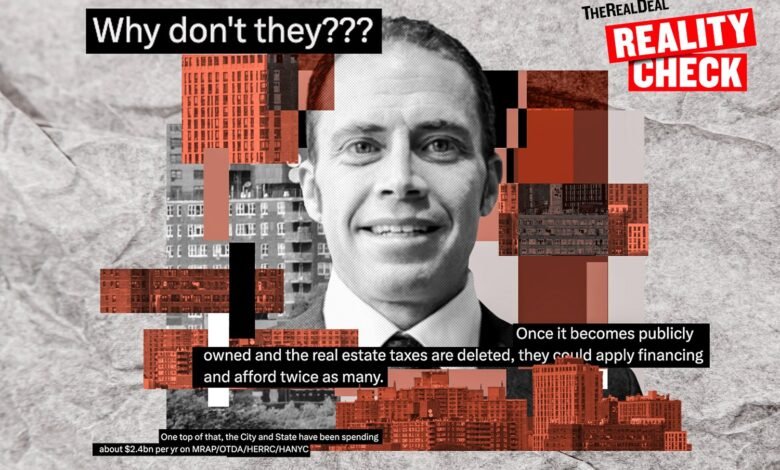
Jamie LeFrak does. The LeFrak Organization executive tweeted this month that the city and state spent more than $4 billion last year to shelter people or subsidize tenants. “In just this one year, they could have instead used this money to buy up 65,000 rent-stabilized apartments in the Bronx,” he noted.
When a reader asked why they didn’t, LeFrak posted a GIF of someone in a chicken costume.
On a serious note, he explained, “There are still people in government who remember what it was like to manage the In Rem buildings.” The city, an unwilling and sometimes inept landlord, stopped foreclosing in 1995 on buildings with tax arrears (though it hasn’t unloaded them all).
Also worth noting is that buying is much cheaper than building. Rent-stabilized buildings in the Bronx can be bought for $80,000 per unit, to use LeFrak’s number. Building affordable housing costs 10 times more.
Examples hit my inbox every week. On Nov. 12, at the site of the former Spofford juvenile detention center in the Bronx, Gilbane and Hudson Companies marked the opening of a 359-unit project that cost $827,000 per unit — even with free land from the city.
These are experienced and respected firms, so that number does not stem from wild spending or lack of expertise. It’s typical for affordable housing in New York City.
Apples and oranges
As with voucher and shelter spending, the high cost of affordable projects raises the question of why the city doesn’t just buy distressed, rent-stabilized buildings.
Stranger things have happened: The de Blasio administration paid the Podolsky family $370,000 per unit for decrepit “cluster housing,” planning to convert them to permanent affordable housing.
One problem with buying traditional rent-stabilized housing is that its vacancy rate is less than 1 percent. City agencies can’t send the homeless and migrants to occupied units.
However, most empty units are not included in the official vacancy rate because they are mothballed. “Rent stabilized units of this sort are only 90 percent occupied, since 10 percent are now withheld from the market,” LeFrak wrote.
He outlined a strategy: “Over time, as units vacate, the city gets them back to reallocate. In the meanwhile they collect current stabilized rents which they can use to [fund] vouchers.”
But as LeFrak himself has observed, the city’s operating costs would be double what rent-stabilized building owners pay. The New York City Housing Authority’s per-unit operating costs in 2022 were indeed twice as much at $1,481 a month, according to the Citizens Budget Commission. “Opex” would consume much of the rent revenue.
As for the warehoused vacant units, most require extensive work — that’s why they’re shuttered. LeFrak estimated renovations would cost the city three times more than private owners pay. Given what NYCHA rehabs cost, he’s probably right.
More evidence of these high costs comes from Mayor Zohran Mamdani’s newest hero landlord, Mark Schwartz.
In September, the mayor celebrated Schwartz’s purchase of three dilapidated Brooklyn buildings from a “negligent landlord,” the Dukler family. The Duklers might not be angels, but a proper renovation would have been challenging to finance, given the meager rent they were collecting.
Even though the city has been making repairs at the buildings for years, Schwartz, who is getting help from the administration, told the City Reporter that renovations will cost from $150,000 to “several hundred thousand” per unit.
“That’s three buildings,” Schwartz said. “How do you do this with hundreds of buildings? I don’t know where they’re going to get the money.”
A building that sells for $80,000 per unit is cheap for a reason: Low rents, rising operating costs or daunting capital expenses, and probably all three.
Benefits of building
Another justification to build rather than buy is that development creates supply, alleviating the housing shortage. Buying buildings does not, unless they have vacant units that are returned to the market.
Also, why would Mamdani have the city buy distressed rent-stabilized buildings if the private sector remains willing to? For all the chatter on social media about the democratic socialist scheming to seize properties, Mamdani lacks the money and manpower to operate these buildings.
Owning them is a thankless task with no political benefit. Any mayor would rather slam their owners than take those arrows himself.
Besides, the cost comparison is deceiving. For example, the city didn’t pay $827,000 per unit at the Gilbane-Hudson project. It subsidized a fraction of that. Affordable developments generally have six to 10 funding sources and sometimes more.
As noted, operating and acquisition costs are inversely proportional: Cheap buildings are expensive to run, and new, expensive ones are cheap to run.
Old properties are inefficient and prone to failures. Heat escapes, facades crumble, pipes leak, boilers conk out and vermin get in. Tenants gripe, call 311, file housing court cases and win rent abatements. Some just don’t pay.
“As for getting nonprofits to run the buildings, they don’t want to,” one source told me. “They are a huge headache and their capital needs puts these not-for-profits at risk.” A nonprofit executive told him he would demand two years’ of operating expenses upfront to take over a distressed asset.
New, affordable buildings are built to high standards. They have efficient HVAC, no cracks for roaches and rodents to exploit, and happy tenants who pay rent. They’re electric, so the city’s gas-pipe regulations don’t apply. The onerous facade law won’t be a problem for years.
“A brand new affordable building isn’t a headache to run,” one source said. “The tenants are all grateful, the appliances are new and the building works.”
The revenue streams are also different. For example, owners of traditional, rent-stabilized units can’t collect more than the legal rent, even if a tenant’s voucher value exceeds it.
All of this explains why, despite the online chatter about Mamdani seizing buildings, it won’t happen until investors and lenders walk away or the buildings fall apart. Whichever comes first.
Read more

NY Dirt: Not just Fannie and Freddie, it’s “everyone”

Who’s still buying rent-stabilized buildings?

“They’re pushing the eject button”: Related unloads monster rent-stabilized portfolio for $192M — another loss

Industry says report proves the 2019 rent law was “disastrous”

The slowest, costliest way to build affordable housing