 Arent Van Curler (1619/20-1667) had performed more than one delicate task for his cousin, the patroon Kiliaen Van Rensselaer (1586-1643), before he rode into the Mohawk country in September 1642.
He had been in New Netherland four years, and he was not yet twenty-three years old.
New Netherland was little more than a geographical expression. Henry Hudson, an English sea-captain, in the employ of a Dutch corporation, had sailed westward in 1609 from the Low Countries across the Atlantic Ocean, instructed to find a short route to the East Indies.
Land blocked his path and he sailed northward and southward, observing each opening in the horizon line. One after another, what appeared to be a strait between islands, proved to be a river, finding its way to the Atlantic Ocean.
The river, which now bears his name, kept him in suspense somewhat longer than the others, but a few days’ sail sufficed to bring him to the near what is now Albany. That voyage, recorded on maps, gave Holland the basis of her claim to the territory from the Delaware River to the Connecticut River.
The European countries, each bent upon securing as much as possible of the western hemisphere, opened up in the sixteenth and seventeenth centuries by the improvements in navigation, more or less recognized the principle that a visit of a nation’s ship to new territory gave that territory to the nation.
Just how much of the territory must be actually visited to perfect the claim was uncertain. Jacques Cartier, in 1534, had sailed up the St. Lawrence River and founded New France. Was New France the spot where he landed, the entire watershed of the St. Lawrence, or the whole of the continent which he had touched?
 Fishermen from Brittany may have sailed up Hudson’s River two generations before Hudson and left a decaying log fort at Albany to testify to French occupation. [This is no longer believed to be true by modern historians, read about it here.]
The Cabots, fifty years before Cartier, explored the coast of North America for England. Who owned eastern North America, and how much of it did he own? There were dark-skinned men and women living in the forests, who had won their subsistence by hard labor, clearing fields with stone axes and precious fire.
Their rights were ostensibly recognized by the Europeans, who purchased from them the right to occupy the forest clearings and the fertile flat lands of the river beds.
In 1642, New Netherland consisted of two small settlements, and a few scattered farms. The settlements were at the mouth of the Hudson River on Manhattan Island and at the head of navigation, Fort Amsterdam and Fort Orange. The farms were dotted along the coast, from Delaware Bay to the Connecticut, and on the islands and both banks of the Hudson River.
Twelve years before, Kiliaen Van Rensselaer, a director of the Dutch West India Company, had availed himself of the privilege of setting up a manor at the head of navigation on the Hudson. The lands were duly purchased from the native occupants, who were glad to receive compensation for property they had their own reasons for fearing to occupy.
[Here the author makes several inaccurate claims about the status of Haudenosaunee (Iroquois) and Mohican settlement and usage of the area, which have been redacted.]Now for a decade, small Dutch ships had brought colonists to Rensselaerswyck, as the manor was called, farmers and artisans for the most part who had bound themselves to work for the manor. It was not easy however, as Van Curler could testify, to make sure that the profits of their labor enriched the patroon and not themselves.
 The patroon, after five unsuccessful years with bailiffs, sent his eighteen-year old cousin, Arent Van Curler of in Nijkerk, Gelderland, the Netherlands, to assist Jacob Planck, the bailiff, with the accounting. The young man was inexperienced in the ways of the counting-house, and it was hard to find time in Rensselaerswyck for the endless copying of accounts and letters, which made up the day’s work of an Amsterdam clerk.
The Holland merchant, accustomed to training young men of Van Curler’s education and station in life, expected him to make good the defects in the written reports of the practical men he had sent out earlier.
But at eighteen, the woods and waters of Rensselaerswyck, the brooks where the trout jumped, the deep pools where the bass swam, the paths where the deer passed from grassy glade to rushing torrent, the flocks of pigeons and wild duck in the sedge grass, had their own training to offer.
It was a training not without its value even for the bailiff of the patroon Van Rensselaer. For, as time proved, sympathy and understanding of the Native People, whose background was the forest, was to make Arent Van Curler the indispensable spokesman of the settlers to them.
So, in this summer of 1642, when Dominie Megapolensis (Johannes Megapolensis, 1603–1670) arrived from Holland, with instructions to recall Arent Van Curler’s zeal for letter-writing, accounting and tedious reports, Van Curler’s neighbors of Fort Orange and Rensselaerswyck entrusted him with the most important piece of work in the forest world.
The Mohawks, one of the five Iroquois nations before whose advance the Mohicans had abandoned the Hudson River lands to Van Rensselaer, were settled some twenty-five miles to the northwest where they controlled the fertile flats of the westerly branch of the Hudson River.
The hunting grounds of the northern slope of the Catskills and of all the Adirondacks were theirs, undisputed. Unfortunately a decade of eager exchange of beaver and otter skins for woolen duffels and dairy products, iron axes and mattocks, whiskey and muskets, had cleaned out the nearby hunting grounds.
To continue the barter with the Dutch. it was necessary to look further afield for exchange goods. There was a vast territory in the Great Lakes country where skins were obtainable, but they had to be secured from the native people of that region.
For a century, these Indian People had used the St. Lawrence River as the thoroughfare for their trade with the French of Montreal and Quebec; and their bark canoes shot the rapids, loaded with hundreds of skins. To the Iroquois of Central New York this was a challenge.
The Huron, who had the carrying trade on the St. Lawrence, were Iroquoian like the Five Nations of the New York region, but the negotiations to include them in the league had failed and left them enemies, an added challenge.
It was inevitable then that the Mohawks and their allies should consider the canoe loads of skins on the St. Lawrence their natural source of supply for exchange goods. They organized raids, in which they went swiftly through the Adirondack country to the St. Lawrence.
The alders along the river provided ambush from which they attacked the long bark canoes of the Hurons, seizing the piles of skins and carrying them on their backs, or strung on poles, south to their villages overlooking the Mohawk.
In the summer of 1642, Rensselaerswyck had word that in one of these raids three Frenchmen had been captured and brought to Ossernenon (Mohawk: Osserné:non, now Auriesville in the town of Glen, Montgomery County), the Mohawk village west of the Schoharie Creek.
The Dutch farmers and carpenters agreed to contribute to their ransom and chose Arent Van Curler to represent them. Leaving the cluster of wooden shacks with thatched roofs that made the West India Company’s settlement of Fort Orange, Van Curler and two carpenters, one of them a Frenchman, rode along the deep trodden path from the Normans Kill to the Mohawk River.
The long-legged, full-bodied horses, bred for the muddy roads of seventeenth century Holland, were alien to these forest trails. But their riders may well have taken on something of an Indigenous appearance, their faces and bodies bronzed by the hot summer sun, their Dutch clothing, suggestive of a Frans Hals portrait, eked out with deer skin jerkins and caps.
On the steep bluff, that overhangs the great flats of the Mohawk River, they paused to let their eyes wander over the golden fields of maize and pumpkins, through which meandered the broad river. For five years, young Arent’s eye had been trained to choose fertile farm sites.
These flats, where the yearly spring freshets dropped rich silt on the islands and low banks, had been cultivated for thousands of years. Van Curler discussed its possibilities with Jean Labatie, the French carpenter.
Along the bluff and over the hills they rode, down into the valley by the water’s edge, and up again to Ossernenon, where the long bark shelters of the Mohawks nestled into the hill-side. Their coming had been long-expected and their welcome was ceremonious.
They halted on the out-skirts of the village, that their hosts might greet them with a volley of musket shots and gifts of wild turkey in return for gifts of duffels and European tools. The chief men of the Mohawk nation gathered from the villages up the river; feasts were held, and games and dances, to celebrate the mutual promises of friendship and neighborliness.
 Among them were Van Curler and his two companions, and the three French prisoners: Father Isaac Jogues, William [Guillaume] Couture, and René Goupil looked more like their Indian captors than emissaries of the Society of Jesus.
Father Jogues was then thirty-five years old, erect, vigorous, accustomed to the hardy regime of the forest. His hands had been crippled, according to the Iroquois war custom, so that they were useless for handling a musket.
He showed little ill effect of the fortnight of walking, by which the Mohawks had brought him a month before, from the St. Lawrence, through the mountain passes of the Adirondacks, to their own broad valley.
Jean Labatie heard from his countrymen the story of their capture as they were returning up-stream from Montreal to the Huron mission. They had accompanied the fur-laden canoes from Lake Huron, spent a few days with the Jesuit fathers at Montreal, and started back, when a band of Mohawks surrounded them and took them prisoner.
Van Curler took his place in the center of the circle of leading Mohawk warriors at their great council fire. He told the Mohawks that the Dutch desired peace and friendship. He offered six hundred guilders worth of woolen duffels and other goods as a ransom for the three Frenchmen.
With calm dignity, a Mohawk statesman replied to the courteous young Dutchman. Friends they would be with the Dutch, but release of French captives was another and unrelated matter. The French had captured some of their own men, had treated them with great severity, even cruelty.
Quietly and courteously Van Curler urged his mission. His manner was that of an Amsterdam merchant, dealing with his peers. The Iroquois felt the difference between this representative of the Van Rensselaers and the bosloopers who penetrated the forests in search of bargains in fur.
[Bosloopers (“wood runners” or “bush runners” in Dutch) were independent Dutch woodsmen and fur traders operating around Fort Orange and the Mohawk Valley, the Dutch equivalent of the French coureurs des bois (“runner of the woods” in French).]They listened, and they yielded in so far as to promise not to put their prisoners to death, but to return them uninjured to their country.
Winter came: the Mohawk country lay deep with snow and the brooks and the rivers were silent. Father Jogues and his two comrades remained in the snow-buried village of Ossernenon.
Spring came: the ice melted, the snow filled the banks of the streams to over-flowing. The Mohawk hung up their snowshoes and took down their fish nets.
At Rensselaerswyck, Van Curler prepared for the spring plowing. The Dutch farmers needed tools from Holland, their accounts became more involved. Barns were begun. Cabins were built over cellars thatched for the winter.
Father Jogues came to Rensselaerswyck one morning in May, with one of the other French captives, to talk things over. Some of the Mohawks had errands at the Dutch trading-post and brought them along.
For the most part the winter had gone well, though they had not been permitted to return north. The food was not bad, but sagamite, the boiled maize [stew] of the Iroquois, grew tiresome after many months.
In the fall, when the men returned from their hunting, Father Jogues refused to eat it since it was offered in a spiritual way. His work was about the bark houses, helping the women with cooking, basket-making, sewing, toting wood, occasionally helping to fell a tree or to make or repair canoes.
Nor had the work of the Society of Jesus been neglected, for he had many a chat with the Huron prisoners, some of whom were already converts, and had encouraged them in their faith. He wished however to return to the Huron mission and renewed his request for Van Curler’s aid.
The summer wore on. Van Curler remembered the dignified churchman and awaited a chance to set him free. Meanwhile the Mohawk war-parties went back and forth from their villages to the French settlements.
There was an affair at Fort Richelieu at the foot of Lake Champlain in 1643, in which, in response to a letter from Father Jogues had manged to have delivered to the French commandant, the Mohawks had been fired upon from the fort.
It was a matter of only a few days before this news created indignation at Ossernenon and throughout the Mohawk country. The Mohawks who came to Fort Orange brought echoes of it to Van Curler, and Van Curler was not surprised when one morning a large dug-out drew up to the Rensselaerswyck dock, carrying two Mohawks and Father Jogues.
Van Curler urged the priest, when he had an opportunity, to board a ship that lay at anchor in mid-stream, waiting for a favor- able wind to carry her to Manhattan. She was bound for the coast of Virginia and La Rochelle. Jogues nodded assent and rejoined the Mohawks who paddled their canoes across to Fort Orange.
The trading Mohawks were sent to sleep at night in the barns on the edge of the village [later known as Schuyler Flatts in Menads] and Jogues and his two guards entered one of these commodious buildings with its high pitched roof.
As darkness came on, they lay down on the straw and soon the Mohawks were fast asleep. Father Jogues crept stealthily along the wall to the door. The door opened suddenly, showing the Dutch farmer’s outline.
 Father Jogues signaled to him to be quiet and the farmer, glancing about, allowed the priest to slip out into the night. All would have been well had not the farmer’s dog sniffed him unfamiliarly, barked and seized him savagely by the leg. The powerful Jesuit shook him off but he had received a serious wound.
Limping painfully, he skulked through bushes and behind outhouses to the water’s edge where he found a rowboat, left there by Van Curler’s order. With extreme difficulty, Jogues launched the heavy boat and rowed himself to the ship.
The captain, warned by Van Curler, took him aboard and stowed him in the hold. At daybreak the Mohawks missed him, gave the alarm and clamored in the streets for his return, threatening an attack on the town.
A Dutch canoe slipped across to give the word to Van Curler at Rensselaerswyck and another hailed the captain of the French ship demanding Jogues’ surrender.
During the third night, Dominie Megapolensis rowed out to the ship for a talk with the Jesuit. Father Jogues listened intently to the dominie’s statement of the situation.
Then the spare, bronzed priest, in his scanty deer skin covering, his tonsure alone denying his native origin, rose, crossed himself and according to the Jesuit Relations spoke with resolution: “Si propter me orta est tempestas, projicite me in mare” (If the storm has arisen because of me, throw me into the sea).
He turned to the captain: “I will go back. God forbid that the settlement should come to harm through me.” A boat was lowered and, in disgust, the captain watched him over the side, following the ship’s boat with his eye till it touched the Rensselaerswyck dock.
Van Curler greeted him with a protest, but Father Jogues waved it aside with a wry smile. When the Mohawks would accept ransom he would escape, not before. The ship sailed.
Father Jogues hid in the attic of the village suttler, who made soap once a fortnight in the wooden barrel in which the priest’s drinking water was stored. Suffering from his wound, the impure water and scanty food and from the fear of detection, Father Jogues lay there for several weeks.
In the meanwhile, Van Curler sharpened his wit, tempered his manner, and met their practiced diplomacy with growing skill, until the day came when they yielded and accepted ransom; Father Jogues was free. The young cousin of the patroon had won his spurs.
Afterward
Also in 1643, Van Curler married the widow of Jonas Bronck, Teuntie Joriaens, also known as Antonia Slaaghboom. In 1662, he founded the settlement at Schenectady on land he purchased from the Mohawks.
In 1663 he had a son by Anneke Schaets, daughter of Gideon Schaets, the dominie of Beverwijck (the community outside the walls of Fort Orange). He also fathered a child with a Mohawk woman, possibly before his marriage to Teuntie Joriaens.
For many years the Mohawk gave governors of New York the title “Corlaer,” owing to high regard in which they held him.
In the winter of 1665-1666 Van Curler aided Daniel de Rémy de Courcelle, the Governor General of New France from 1665 to 1672, during a troubled expedition to the Mohawk Valley during which he supplied the starving French at Schenectady with provisions.
The Jesuit Relations record that over 60 men died from hunger during the expedition, however Captain Francois de Tapie de Monteil of the Poitou Regiment wrote in his journal that “we lost 400 men who dropped dead from cold.”
Courcelle accompanied Alexandre de Prouville de Tracy on an expedition against the Mohawk in the autumn of 1666 that destroyed four Mohawk villages, resulting in a peace reached by July 1667.
 In the following year of 1667, on a trip to Quebec at the invitation of Governor de Tracy he drowned in Lake Champlain (Mohawk: Kaniatarakwà:ronte) when his boat overturned during a storm near Split Rock, where Whallons Bay meets the main body of Lake Champlain.
In 1690 a raiding party of 114 French soldiers and militiamen, accompanied by 96 allied Mohawk and Algonquin warriors, attacked the unguarded community of Schenectady in what is now known as the Schenectady Massacre.
In 1925 the Hotel Van Curler was constructed in Schenectady, it is now Elston Hall of Schenectady County Community College. Van Corlaer Elementary School in the same city, built in 1914, is also named after him. In Nijkerk, his birthplace in the Netherlands, two districts and two schools named after him.
Read More About Arent Van Curler
The essay was first read as a paper read before the New York State Historical Association (NYSHA) by Winnifred Notman Prince (Mrs. David C. Prince) of Swarthmore, Pennsylvania, at Schenectady on September 25, 1931. It was published, with sources in The Quarterly Journal New York History of the New York State Historical Association,Volume 13 (1932). It was edited, updated, and annotated by John Warren.
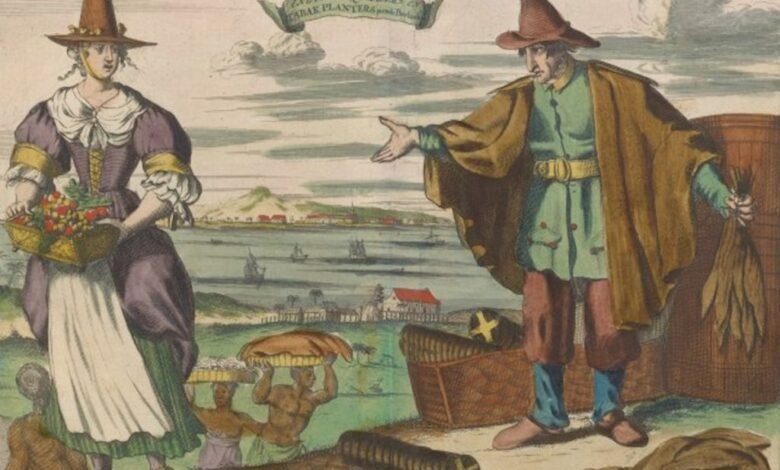
Illustrations, from above: An illustration of New Netherland, including slaves and the Hudson River (New Netherland Institute); “Novi Belgii Novaeque Angliae nec non partis Virginiae tabula” map of New Netherland by Nicolaes Visscher, ca. 1684 (Koninklijke Bibliotheek, Den Haag); a Van Curler letter to the patroon partially burned in the 1911 NYS Library fire – the only van Curler letter to survive the blaze; a plaque dedicated to Isaac Jogues at Ossernenonin, now Auriesville, Montgomery County; 1757 map showing The Flatts and Hudson River islands since filled (Courtesy of the Town of Colonie Historian); and Split Rock appears as “Roche Persée” (Roche Percée, Pierced Rock) on a 1711 map, “Carte du Canada tirée sur un très grand nombre de mémoires des plus récents augmentée et corrigée sur toutes celles qui ont été faittes avant,” created by Jean-Baptiste de Couagne.
Source link