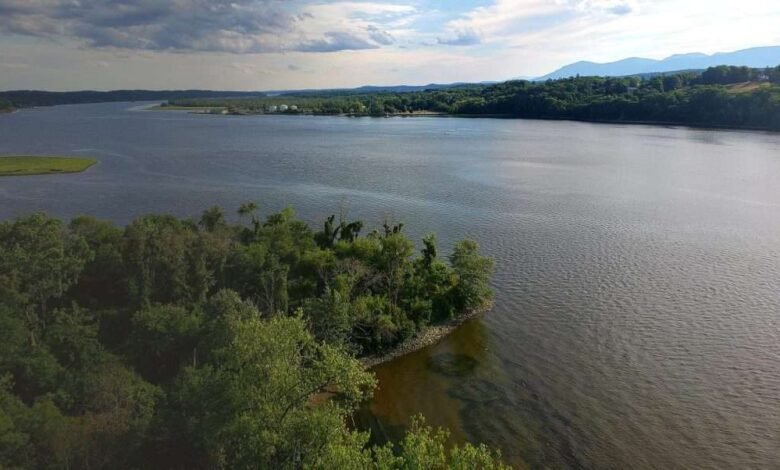
 The Hudson River begins as a small mountain lake on the side of the state’s highest peak Mt. Marcy and ends in New York Harbor, one of the world’s busiest and most populated metropolitan ports. About halfway along its course it becomes an estuary, an arm of the sea, that provides spawning and nursery grounds for commercially valuable fish, crabs, and shellfish.
The River’s uplands are covered with forests interspersed with working farms, residential development, and small cities. These lands support a high diversity of species of global and national significance.
The Hudson Valley’s varied geology creates a tapestry of habitats, such as pine barrens, grasslands, cliffs, mountain ranges, caves, streams, and wetlands, including globally rare freshwater tidal wetlands. This mix of habitats gives the region exceptional importance.
The region, comprising only 13.5% of the land area of the entire state, contains nearly 85% of the bird, mammal, reptile, and amphibian species found in New York State. It is important worldwide for its rich diversity of turtles, and nationwide for its dragonflies and damselflies.
It offers opportunities found nowhere else in the state for conservation of amphibian and reptile biodiversity. A number of species use the Hudson Valley as a migration route or as breeding or nursery habitat.
This includes migratory fish such as shad, sturgeon, and striped bass, as well as insects such as the monarch butterfly. Birds as varied as the cerulean warbler, marsh wren, bald eagle, osprey, and ruby-throated hummingbird all spend part of their life cycle in the Valley and part of it in places as far away as Nova Scotia and South America.
The Hudson River Estuary ecosystem is home to a number of species that have their best or only remaining populations in the region. Such species include the northern cricket frog, sable clubtail dragonfly, Kentucky warbler, timber rattlesnake, the bog turtle, Karner blue butterfly, and Indiana bat.
Approximately 150 species in the watershed are listed by the NYS Department of Environmental Conservation (DEC) as threatened, endangered, or of special concern in New York State. Of the 11 turtle species found in the Hudson Valley, six are on state or federal lists of endangered, threatened, or special concern animals, primarily due to habitat loss.
While some species flourish in the Hudson River Valley, others are threatened and some species not now listed as endangered are on the decline. Urbanization and habitat fragmentation are a major concern.
Species that require connections between habitat types to complete stages in their life cycles cannot survive if these connections are broken. For example, wood frogs, spotted salamanders, and marbled salamanders require wetlands for breeding and must have adjacent woodlands for their adult stage.
Animals that rely on large unbroken tracts of forest, such as the bobcat, wood thrush, cerulean warbler, and red-shouldered hawk can become vulnerable when such forest lands are broken up.
Agricultural lands also provide important habitat. Meadows and shrubby fields found on Hudson Valley farms can support species such as the bog turtle, northern harrier, bobolink, meadowlark, and golden-winged warbler. Many of these species are declining in the valley as agricultural land uses decrease.
 Pollution and competition with invasive or overabundant species create problems for some species. At least 10 percent of the 3,600 miles of tributary stream habitat in the Hudson Valley are stressed from agricultural and urban runoff, erosion, dams, loss of riparian buffers, and reduced groundwater recharge.
Invasive species crowd out native species that serve as food and shelter for many of the regions insects and small animals. Many of these “invasives” take hold where human practices give them an extra boost.
The region is one of the most densely populated areas in the country, and its land is changing fast.
According to a report released in 2001 by the Brookings Institution, between 1992 and 1997, urbanized land use in the NYC metropolitan area grew at three times the rate of population growth, and in the Albany Capital District urban land use grew at six times the rate of population growth.
This rapid land conversion creates an urgent challenge to organizations and agencies faced with finding new ways to include conservation in the region’s growth strategy. Protecting habitat does not require that growth stop however, human developments will need to be sensitively placed to maintain important habitats and fit the needs of wildlife species.
Public lands are making an important contribution to biodiversity conservation in the Hudson River Valley, particularly for species that require large forested tracts. A century of open space acquisition has created large intact habitats in the Highlands, the Palisades, the Taconics, and the Catskills.
However, 90% or more of the suitable habitat for the region’s birds, mammals, amphibians, and reptiles is found on private lands. Furthermore, 23 of these species are not thought to occur at all on public land.
While land acquisition will play a role in protecting some of these species, it cannot be the primary strategy. These trends highlight the need for conservation options that can be adopted by interested parties.
Read More About the Hudson River Estuary
This essay is drawn from the Hudson River Estuary Wildlife and Habitat Conservation Framework. The Framework describes key plant and animal habitats in the 15 New York State counties bordering the Hudson River Estuary from the Federal Dam at Troy to its confluence with the Atlantic and identifies strategies for the protection of these habitats. It was developed as part of the Hudson River Estuary Action Agenda, led by the New York State Department of Environmental Conservation.
Illustrations, from above: The Lower Hudson River (courtesy Cary Institute)and a Hudson River Estuary restoration project, 2022.
Source link