 Among the pieces of artillery collected by Henry Knox at Fort Ticonderoga for delivery to George Washington in Boston were some originally intended to support the Invasion of Canada – a 1775 event few Americans acknowledge, let alone commemorate.
Was the invasion of Canada imperial over-reach by the Second Continental Congress, an unprovoked act of aggression, a strategic maneuver to seize control of the Ohio Valley and the Great Lakes? Or was it a preemptive, defensive measure, intended to spare the thirteen colonies a British invasion from the north?
“Those are good questions, which, 250 years later, deserve our reflection,” says Rick Atkinson, the Pulitzer Prize winning historian of the American Revolution.
“How a war ostensibly fought for basic rights and political freedom could devolve into an act of naked aggression, into a battle
for a 14th colony, which could not be taken by blandishment or negotiation, speaks to today’s events,” Atkinson told the Lake George Mirror last year.
“People who think that Canada ought to be the 51st state should take a look at what happened in 1775. It did not go well.”
According to Atkinson, a featured contributor to Ken Burns’ documentary The American Revolution, our invasion of Canada, a detachment of which left from Fort Ticonderoga, was “to a large extent, a catastrophic debacle.”
 It is “a strange story,” concedes Eliot A. Cohen, a military historian and former Fort Ticonderoga trustee whom Atkinson cites in The British Are Coming, the first volume in his trilogy about the Revolution.
In May, 1775, Congress dispatched a letter addressed to Canadians, published widely and translated into French, claiming, possibly disingenuously, that “the taking [of] the fort and military stores at Ticonderoga and Crown Point, and the armed vessels on Lake Champlain” were entirely defensive and not, as many Canadians suspected, the spear tip of a planned invasion.
The letter also enjoined the Canadians to unite with their fellow North Americans in “resolving to be free, and in rejecting, with disdain, the fetters of slavery.”
Perhaps the invasion was undertaken on behalf of a doctrine, albeit an armed one, advancing democracy and individual rights – an early example of American exceptionalism.
“Of course, in retrospect, it’s easy to see the inconsistency between our assertion of our right to self-governance and our wish
to impose our political will upon a neighboring country, in this case, Canada,” Atkinson said.
“It foreshadowed a belligerence and a tendency to trample upon the rights of self-determination of others, including those of the
Native American tribes.”
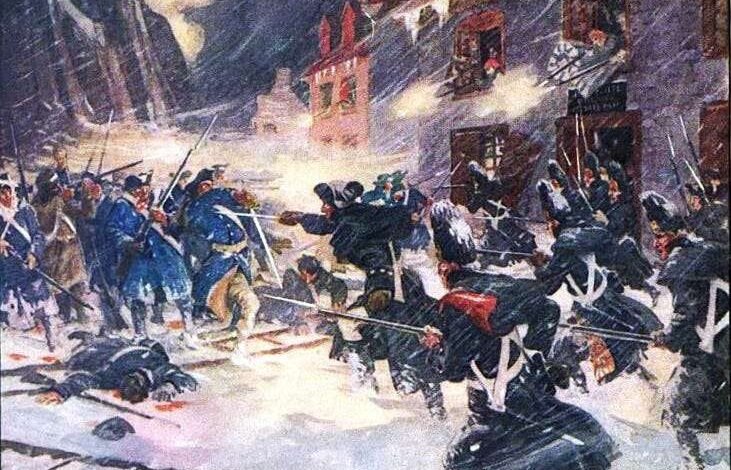
But no matter the reason it was launched, the campaign ended ignominiously in the spring of 1776, following an unsuccessful
siege of Quebec City and the death of its military commander General Richard Montgomery in December, 1775.
After the retreat from Canada, the Continental Congress did not engage in much self-reflection about the causes of its army’s defeat – as little as it gave to the causes of the invasion, or to its motives for launching it.
“So ended a botched campaign of liberation and aggrandizement, laden with miscalculation and marred by mishap,” Atkinson writes in The British Are Coming.
Even if the Americans had succeeded in taking Quebec, the victory would have been a short-lived one, Atkinson said.
“The British would have counter-attacked in force. It was never in the cards for this to succeed,” said Atkinson.
Nevertheless, the “dream of incorporating Canada into the United States persisted throughout the Revolution. Lafayette himself would have liked to lead an army into Canada. It took a while for this dream of the 14th state to subside,” he said.
As Atkinson said in our interview, “The dream of being the continental power was firmly planted in the mind of the founding generation.”
The use of the word “continental” when naming the congress and the army was no accident. It was a reflection of the founders’ ambitions. Although the invasion of Canada “was a footnote to the history of the American Revolution, and even smaller footnote to the history of the republic, its lessons are germane today. It’s a cautionary tale,” said Atkinson.
The Lake George Role
Lake George played a significant role in the invasion of Canada, in the beginning, middle, and aftermath of the campaign.
Once Congress decided to invade Canada, “Lake George emerged as a crucial water highway, carrying supplies and reinforcements for the American army during the subsequent invasion. Hundreds of barrels of pork, flour, and other provisions were transported to Fort George from Albany,” says Russell Bellico.
Bellico is author of Empires in the Mountains: French and Indian War Campaigns and Forts in the Lake Champlain, Lake George, and Hudson River Corridor and Sails and Steam in the Mountains: A Maritime and Military History of Lake George and Lake Champlain, among other books on the two lakes.
British soldiers captured by the Americans in the early weeks of the campaign were interned at Fort George – among them, Lieutenant John Andre, who was subsequently paroled and who later conspired with Benedict Arnold to hand West Point over to the British, says Bellico.
In April, 1776, the embassy to Canada, commissioned by Congress to gauge support for the American cause, the one that included Benjamin Franklin, took refuge there.
Once the invasion collapsed, Fort George became, as Bellico has shown, the largest military hospital in North America, housing the troops who had contracted smallpox during the unsuccessful campaign.
Horatio Gates, who replaced Philip Schuyler as commander of the Northern Army in June, wrote George Washington that the survivors were “infected with pestilence… To put this evil from us, a General Hospital is established at Fort George… where every infected person is immediately sent.”
By August of that year, roughly 2,000 patients were being treated at the new hospital, with twenty to thirty dying every day. The graves discovered in Lake George Village in 2019 are among the hundreds that held the bodies of those who died from smallpox and other diseases at the hospital.
Dr. Lewis Beebe, a 27-year-old doctor traveling back and forth between Fort Ticonderoga and his home in Massachusetts and who stopped more than once at Fort George, wrote that as of August, 1776, three hundred graves had been dug at the cemetery, which he called “the burying place.”
It made him “melancholy,” he wrote in his journal, “to see such desolation made in our army.” Troops who had not contracted smallpox were sent to Fort Ticonderoga and remained there until John Burgoyne’s British troops seized it in October, 1777.
A Memorial Plaza holding the remains of those who died at the Fort George hospital and which were found in Lake George Village in 2019, was dedicated in May, 2026.
Read More About the Invasion of Quebec
A version of this article first appeared on the Lake George Mirror, America’s oldest resort paper, covering Lake George and its surrounding environs. You can subscribe to the Mirror HERE.
Illustration: “Arnold’s column is shattered in fierce street fighting during the Battle of Quebec” by the Canadian artist Charles William Jefferys, 1916.
Source link