 Where there is money, there are cheats; wherever value moves, deception follows. Levels of corruption fluctuate across various eras in history, peaking at times of rapid change, dubious oversight, or weak authority. Certain ages are more deceitful than others. In Dante Alighieri’s Inferno, fraudsters occupy the Eighth Circle of Hell (Canto XVIII).
Ever since coins began circulating, individuals have tried to mint fake ones. Greek and Roman crooks plated base metals with thin layers of gold or silver. Others clipped slivers of precious metal from the edges of coins, melted them down, and made new ones.
 Medieval Europe treated counterfeiting and coin clipping as offenses against the sovereign. As the circulation of fraudulent currencies undermined state power, harsh punishments were meant to serve as a deterrent. Forgers were boiled alive or burned at the stake.
In England, during the reign of Henry I, coin-fraudsters had their right hand amputated and their testicles removed.
In 1694, King William III of Orange chartered the foundation of the Bank of England. When in 1696 Isaac Newton became Warden of the Royal Mint, he instructed his officers to track down forgers and prosecuted counterfeiter William Chaloner.
Found guilty of High Treason, the latter was hanged at London’s gallows at Tyburn in March 1699, disemboweled, and quartered in front of a massive crowd of rowdy spectators.
Counterfeiting & War
The term “fraudfare” is used in cyber security circles to describe financial deception in a context of international conflict. Coined specifically to name state-backed digital scams, the concept itself has a long history and is relevant to the American Revolution. Starting in Antiquity, governments have used fake coinage as a weapon of war.
During the Seven Years’ War (1756–1763), Frederick the Great distributed counterfeit Russian and Polish currency to bankrupt regional economies. Napoleon Bonaparte sanctioned the circulation of bogus Austrian notes to cripple the nation’s war funding.
 Nazi Germany launched “Operation Bernhard,” forcing prisoners at Sachsenhausen concentration camp to forge British pound notes. The plan was to mass drop high-quality fakes over the country to trigger hyperinflation.
When printed banknotes first came into European use during the 1660s, a major problem manifested itself. Since a paper note has no intrinsic value, there was nothing to stop issuing authorities from printing more than they had specie to support it. The “bubble” popped when people demanded hard cash instead. Paper currency was suspect, the “shadow of a shade” (Robert Southey, 1829).
Bank notes were put in circulation at the Massachusetts Bay Colony when, in 1690, its leaders issued “bills of credit” to finance King William’s War (1689-1697) against French colonists and their Native allies. Fraud followed.
Born Mary Peck, Mary Butterworth ran a “cottage-industry” out of Rehoboth, MA, that forged colonial bills between 1716 and 1722. Put on trial in 1723, she was released because of a lack of evidence. Mary proved that a career in counterfeiting was not gender-dependent and open to all talent.
Massachusetts set a precedent. Between 1775 and 1779, the Continental Congress ordered the issue of dollar notes, known as “Continentals,” to finance the Revolutionary War.
Facing the need to pay soldiers with minimal access to credit and no authority to levy taxes, colonial leaders turned to the printing press, using bills of credit as their financial engine.
Individual colonies followed suit and issued their own notes. As there was no physical backing in gold or silver (and a shortage of high value coins), the roll-out relied on paper-thin public trust.
Exploiting the currency’s vulnerability, British authorities began mass-producing counterfeit bills in a campaign to collapse the rebel currency. From around January 1776 through to April 1777, the Royal Navy frigate HMS Phoenix ran a counterfeit printing scheme whilst anchored in New York Harbor.
Supported by Loyalist merchants such as Irish-born George Folliott alongside other Tory agents, the military printed millions of dodgy Continental bills, distributing them into the colonial economy through a network of partisans, spies, and self-seekers.
 Its inflationary impact shattered confidence in the currency. By the end of the decade, inflation was almost fifty percent, a suit cost a million Continentals, giving rise to the phrase “not worth a Continental.”
The Continental Congress treated counterfeiting as a capital offense and convicted individuals caught printing or handling fake notes. Loyalist agents David Farnsworth and John Blair were executed with George Washington’s approval in 1778.
It did not prevent the crash. By 1781, the currency had collapsed, almost bankrupting the rebellion, and forcing Patriots to rely on foreign loans. The early Republic was drowning in debt.
Although the war ended in 1783, the nation’s finances remained messy throughout the 1780s. In 1785, the dollar (and its symbol) became the official monetary unit; a year later, the Mint was established in Philadelphia; the Continental Congress received taxation powers in 1787; and Alexander Hamilton established the Bank of the United States in 1791.
It took considerable time to bring about coherent fiscal and monetary policies – New York suffered more disruption than other major city.
Chaos & Corruption
Following the departure of British forces on November 25, 1783, the city of New York faced a critical period marked by a refugee crisis, financial ruin, and infrastructural collapse, leaving the devastated city exposed to crime and corruption. Demobilized soldiers, starving residents, freed slaves, and an army of swindlers and speculators swamped the city.
The new reality stirred retaliatory violence, looting, and vigilante justice. Many desperate souls turned to robbery or petty theft. Returning New Yorkers found their homes occupied by others or seized under confiscation acts. Property dealers and crooked officials manipulated the legal void to claim prime real estate.
In the wake of war, New York’s trading activities recovered although the city lacked not just a federal currency, but also basic banking precautions such as reliable records. Monetary mayhem and an abundance of poorly regulated currencies made merchants vulnerable.
Chancers and swindlers took advantage. Counterfeit fraud was rampant. The shadow economy thrived.
Stock chicanery followed. Much of the nation’s industrial might was built on rackets and deception. Devon-born and Eton-educated William Duer, a former Assistant Secretary of the Treasury, was America’s first corporate swindler and insider trader. He endangered the fledgling stock market.
When his financial empire collapsed and Duer ended up in prison, twenty-four Wall Street brokers met beneath a sycamore tree in Wall Street to regulate trade by signing up to the “Buttonwood Agreement” in May 1792.
In the late 1780s, New York City was a wilderness of unchecked speculation and “wildcat” banking, creating a culture of High Finance and Low Morals. The word swindler entered the English language in the 1770s as a loan word from the German noun “schwindler” (speculator or cheat).
Once in American use, it shifted in meaning to describe a person who spins tales to defraud others.
The word’s introduction coincided with the arrival in America of Johann Jakob Astor from Walldorf (near Heidelberg) in 1783/4. Having made a fortune in the fur trade, John Jacob began buying up Manhattan properties, running his conglomerate in a ruthless manner that laid the groundwork for future real estate barons. New York turned into a City of Swindlers.
Shoving the Queer
A cryptolect is the secret vocabulary of marginalized groups used for internal communication. It hides conversations or identities from outsiders, be they police officers, tax collectors, or professional rivals. In sixteenth-century England such argot was known as “Thieves’ Cant.” Spoken by criminals and vagabonds, it concealed illicit activities (also known as “peddler’s French”).
 As thousands of British immigrants settled in New York during the 1800s, they brought the jargon with them. In 1859, the city’s first police superintendent George Washington Matsell published Vocabulum; or, The Rogue’s Lexicon, documenting gang slang of the notorious Five Points district. His dictionary served as a guide for officers to decipher the underworld’s coded language.
A tsunami of state banknotes hit New York during the mid-nineteenth century as thousands of private banks, corporations, and municipalities issued their own paper money. Currency instability made counterfeiting a boom industry with its own distinct jargon.
Matsell dedicated a lengthy section to the practice of circulating bogus notes. Operations involved a two-person team to limit the risk of arrest. There was the shover who physically passed counterfeit currency (“shoving the queer”), carrying just one fraudulent note at a time. If caught, he could claim not to be aware of foul play.
His mate in crime followed closely, carrying the stash of fake notes (“boodle”), and supplying his partner with fresh bills when given a signal. In nineteenth-century slang, “queer” meant anything fraudulent or fake. A counterfeit coin was a “queer bit;” a fake banknote a “queer soft.”
The criminal hierarchy was topped by printers and engravers who manufactured the bills. They were known as “coney-men.” The word has an English resonance. In sixteenth-century slang, coney-catching referred to theft through trickery (derived from “coney,” rabbit or dupe).
A coney man was a confidence trickster. In American slang, the term’s meaning shifted to a person who produced counterfeit money.
 Connecticut-born William Brockway, “King of Counterfeiters,” set up shop in Manhattan and Brooklyn around 1850, studied chemistry at Yale to perfect his ink replication, and worked with skilled engravers to create flawless fakes.
Professional counterfeiters sold batches of bills to shovers at a discount who would then visit shops and markets to buy goods, receiving legitimate currency in exchange.
Gangs of shovers orchestrated high-speed “forays” into Manhattan, flooded stores with counterfeit bills, and dispersed before local authorities could respond. It became an increasingly structured set up with local cabals controlling the shoving rings.
New York’s police response focused on breaking up networks rather than hunting down untouchable “master” printers and engravers. Despite arrests, a fragmented police force was unable to deal with the crisis. The sheer number of private (compromised) banks made a true crackdown impossible to impose.
 The Civil War further complicated the situation. It created a “shoddyocracy” of profiteers who enriched themselves by selling substandard goods and uniforms to the United States military. In addition to the crippling cost of the conflict, a string of financial scandals and “panics” paved the way for institutional restructuring and law enforcement.
It forced Congress to pass sweeping legislation such as the Legal Tender Act (1862) and the National Bank Act (1863), but these interventions did not remove the “stigma of regulation.”
For many politicians and business tycoons, proactive prevention was a taboo subject. Regulation was a repair shop. Management of artificial intelligence (AI) will be the next combat zone in the cycle of conflict between corporate power and civil protection.
Read More About Crime and Justice in New York
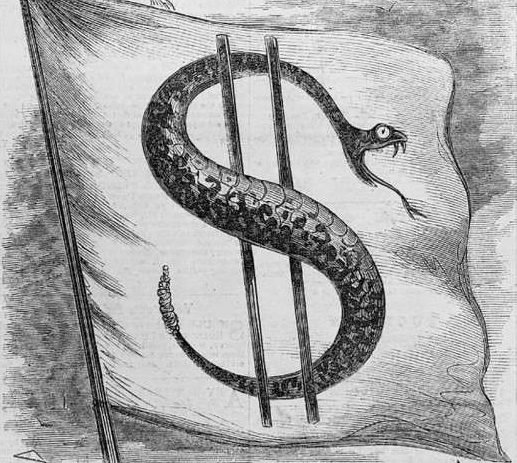
Illustrations, from above: Sandro Botticelli, The 8th Circle of Hell, illustration from Dante’s Inferno, ca. 1485; counterfeiters would clip metal from coins (left) and use the clippings to make new coins (right); a first edition of George Matsell’s Vocabulum; or, The Rogue’s Lexicon, 1859; a Bank of England note forged by the Nazis during World War Two; a continental dollar, 1776; William E Brockway, forger and counterfeiter; and a Civil War advertisement using the dollar symbol as a snake, 1861 (Library of Congress).
Source link