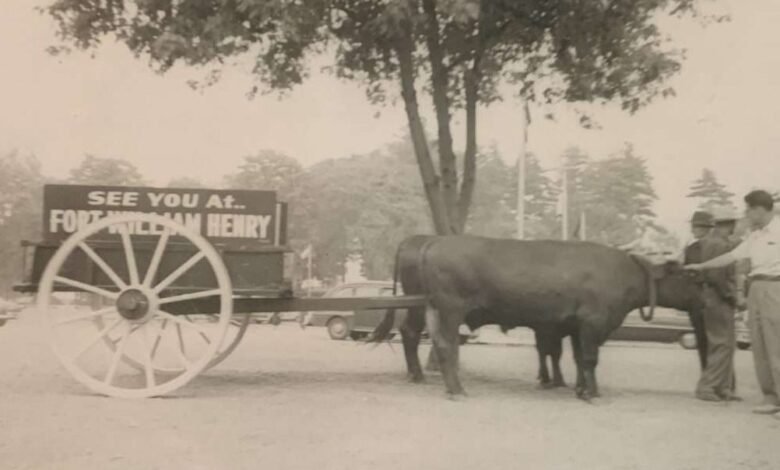
 The June 24, 1954 minutes of Fort William Henry Corporation’s Board of Directors lists a “team of oxen purchased for advertising purposes.” The cost was $400. The acquisition of the two bovines were used to illustrate the life-ways at the historic fortress from 1755 to 1757.
In 1952, when Fort William Henry Corporation was founded, the for-profit entity’s purpose was to construct a replica of the British-colonial fortress for tourism.
Archaeologist Stanley Gifford, a Syracuse native, was hired to direct a dig on the grounds to collect artifacts for exhibit and to determine the precise location of the historic wood-and-earthen structure.
In an article in the Syracuse Post-Standard dated May 2, 1954, Gifford (who was assisted by his wife Ruth) said they found, “Thousands of animal bones, including oxen, deer, bear, and elk.” Two weeks later, the reproduction fortification opened.
 During the French & Indian War (1755–1763) and American Revolution (1775–1783), oxen were the preferred “beasts of burden.” Most commonly a castrated males (steers), they were known for their endurance and their ability to traverse adverse terrain.
Further, they were less prone to injury than horses. Unlike equines that required good hay to eat, oxen often consumed moldy food. However, oxen were slower than horses.
Both horses and oxen often needed to be shod, that is, wear metal shoes to protect their hooves. It was more difficult to shoe an ox then a horse.
Oxen had difficulty standing on three legs during shoeing and had to be hoisted via a sling or laid on one side. Oxen have cloven hooves, and their metal shoes are fashioned in two halves unlike horse shoes.
News accounts in the autumn of 1954 reported that the two “red” oxen at Fort William Henry Museum were Devons.
They had medium-to-long curved horns that were light colored, except for dark tips. Over the off season when the museum was closed, the Devons were kept at a farm near Friends Lake, near Chestertown, New York.
Though corporate records say the oxen were acquired for “advertising,” they frequently were employed over 1954–1955 to move construction materials along the replica fortification’s ramparts.
 According to newspaper reports, most of the reproduction fortress was finished by late summer 1956, but some final touches were not completed until the following year.
In 1997, Dr. David Starbuck, an archaeologist from Chestertown who dug at Fort William Henry, commented to Associated Press reporter Chris Carola about the site’s drinking well.
Starbuck observed, “I could see the French and Indians throwing in something to pollute the water, maybe [the carcasses] of some oxen.”
Though contaminating the drinking water of the enemy may have been done in colonial warfare, it has been difficult to substantiate.
The acquisition of oxen by Fort William Henry Corporation in 1954 depicted how British soldiers in the 1700s would have utilized these animals. Oxen were needed for building purposes, as well as pulling wagons along the “military road” from Fort Edward to Lake George.
Read More About the Use of Oxen in New York
A version of this article first appeared on the Lake George Mirror, America’s oldest resort paper, covering Lake George and its surrounding environs. You can subscribe to the Mirror HERE.
Illustrations, from above: The Fort William Henry oxen being used for promotion in the mid-1950s (courtesy Fort William Henry); the pair of the yoked oxen which helped move building materials during the construction of replica Fort William Henry in 1954-55 (Fort William Henry); and a postcard showing the north side of replica Fort William Henry in the late 1950s, shortly after it was rebuilt (unknown photographer, from the author’s collection).
Source link