The work of CO-OP NWJ has always been grounded in the understanding that economic, cultural, and political conditions are inseparable. Our approach centers on collective ownership, resident leadership, neighborhood-based enterprise, and the belief that a community’s own story, skills, traditions, and creativity are assets rather than deficits. We often say that “our story is an asset,” that “art is an intrinsic value linking people to place,” and that “the work can never outpace the people.” Those values have shaped everything we’ve built.
The dream is not a new one. It is one that grassroots organizations and movements have fought for and built toward for many generations. And as we, the dreamers and schemers of a better future continue to resist and insist on equity, justice, and complete liberation, it is encouraging that more people across many sectors are pivoting to dreaming as part of the doing.
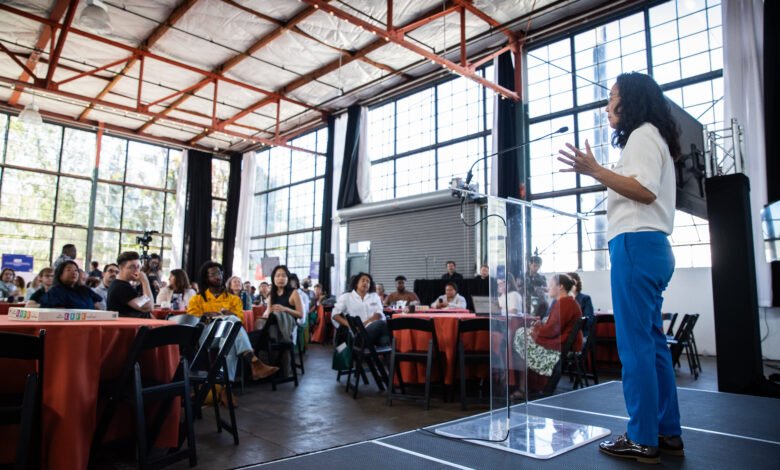
One of the most striking aspects of the convening was the range of perspectives represented in the room. Conversations moved fluidly between arts and culture, housing, labor, agriculture, education, healthcare, finance, and community ownership.
Rather than feeling fragmented, those discussions revealed how deeply interconnected these issues really are.
A housing conversation quickly became a conversation about creative practice.
A discussion about labor led naturally into questions of ownership and power.
A presentation on community wealth building opened the door to conversations about cultural preservation and self-determination.
By the end of the day, it was difficult to imagine discussing any of these topics in isolation.
I was particularly moved by the number of artists and cultural workers who were already engaged in building alternative models within their communities. There is often a tendency to think of artists primarily as creators of cultural products, but the convening highlighted another reality, that artists are frequently among the first people to imagine and experiment with new ways of organizing social and economic life.
That observation felt especially meaningful given my role as creative director at CO-OP NWJ where art isn’t an add-on to community development. It’s woven into the work itself. Creative placemaking, folk art, storytelling, and preserving cultural narratives are all part of how we rebuild relationships, trust, and strengthen community identity. Art helps us remember who we are. It helps us imagine who we can become. And it helps ensure that transformation doesn’t come at the expense of the people and culture that already exist within a place. It is the glue that holds the community together.
Another theme that continued to surface throughout the day was trust.
We are living in a moment of deep institutional distrust. Communities across the country have experienced decades of disinvestment, exclusion, and broken promises. Rebuilding trust will certainly require policy changes and institutional reforms, but I left the convening knowing that those interventions alone will never be enough.
Trust is relational, and it develops through participation. It grows when people have meaningful opportunities to shape decisions, steward resources, and exercise agency within their own communities. Democracy, in that sense, isn’t simply a political structure. It’s a social practice.
And perhaps one of the most valuable contributions of community-based work is that it creates spaces where people can practice building together.
At CO-OP NWJ, that practice is visible in our commitment to neighbor labor, collective ownership, and resident-driven decision-making. We intentionally move at the pace of the community because we understand that sustainable transformation can’t be imposed from the outside. The people most affected by change must be active participants in creating it.