 One fall day Dave Anderson, a forester, and three friends gathered at the base of a giant tree with patchy gray, tan, and white bark. Joining hands, they formed a ring around the trunk of New Hampshire’s largest American sycamore.
They estimated the tree’s age to be more than 300 years; its height and crown each spread more than 100 feet, and its circumference was 18 feet.
It is not New England’s biggest specimen. That honor may belong to the Pinchot Sycamore on the bank of the Farmington River in Connecticut or the Buttonball Tree in Sunderland, Massachusetts. New York State’s largest recorded sycamore is located in Dutchess County.
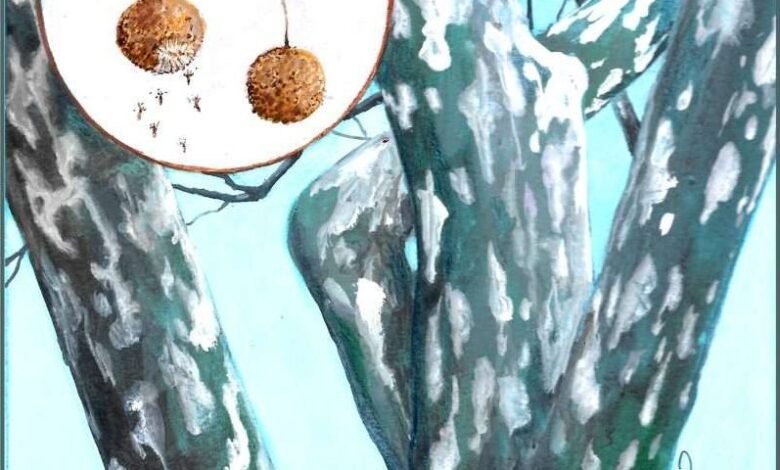
Platanus occidentalis is the largest deciduous hardwood in North America, native to eastern and central United States. It is easily recognized not only by its size and peeling bark, but also by its seed balls, aggregates of achenes, which hang from single stalks like Christmas tree ornaments. These give the tree its common names: buttonball or buttonwood.
(It was a sycamore that gave it’s name to the Buttonwood Agreement, the foundational document of the New York Stock Exchange, signed on May 17, 1792, by 24 stockbrokers and merchants under a buttonwood tree near what is now 68 Wall Street in Lower Manhattan.)
“American Sycamores are native trees, but their range is limited,” Anderson said. “They’re specialized as a riparian species, confined to alluvial soils along major rivers such as the Merrimack and the lower Connecticut River. They can’t stand to be constantly flooded and will die if inundated for long.”
These trees occur singly or in small groves, often in the company of moisture-loving species such as red maple, willow, and cottonwood. The sycamores you see in urban settings are most likely not native; they are probably London planetrees, a hybrid between P. occidentalis and P. orientalis, a species native to southeastern Europe and western Asia.
London planetrees were widely planted along city streets because of their rapid growth and tolerance of air pollution.
While the hybrid can look similar to the American sycamore, it has more olive-green bark, seed balls that come in pairs, and deeper cuts between the leaf’s lobes.
The reason for the sycamore’s unusual habit of peeling is that its bark lacks the elasticity that allows it to stretch as it grows. American sycamores are fast-growing, adding up to two to three feet in height per year in the proper conditions.
“Sycamore bark doesn’t expand as fast as the tree grows, so outer layers flake off in irregular patches,” Anderson said. “The white color you see on the tree’s upper trunk and branches is the newly exposed inner layer.”
Because exfoliation happens on the young upper branches, which are expanding faster than the brown-gray lower trunk, a mature sycamore almost looks like two different trees stacked one on top of the other.
In the fall, sycamore leaves turn yellow gold, then dull brown. The leaves are similar in shape to those of maple trees, and roughly the same size as those of silver and sugar maples.
They are irregularly toothed and have three to seven lobes separated by shallow notches. After the leaves fall, the beauty of the trees’ creamy upper branches is clear to see.
Besides being impressive to look at, sycamores are ecologically important. The dangling fruit balls that persist through the fall and winter contain thousands of high-protein seeds, which are dispersed by the wind in early spring and provide food for small birds.
The sap is favored by yellow-bellied sapsuckers, which create wells in the bark. These wells in turn trap insects in the sap, which are then dined upon by hummingbirds, porcupines, and other animals.
Caterpillars feed on the foliage, and the bark is browsed by deer, porcupines, and beavers. And beyond just nutrition, sycamores offer shelter. Their heartwood is prone to injury and decay, so mature trees develop cavities that birds and mammals can inhabit.
“These giant trees are often hollow, which doesn’t necessarily mean they are dying,” Anderson said. “It’s just concentrating its strength on the outside.” Woodpeckers, owls, cavity-nesting ducks, flying squirrels, raccoons, and even black bears take up residence.
The cavities are perfect for chimney swifts. These birds cannot perch well on branches but can roost by clinging to the rough vertical surface inside the hole.
According to many legends, these hollows have even sheltered human beings; stories tell of travelers and deserting soldiers seeking safety in them. Whether these stories are fact or folklore, I can’t help wondering what Concord, New Hampshire’s enormous American sycamore would tell me if it could speak.
Read More About New York Trees
Laurie D. Morrissey is a writer who lives in Hopkinton, New Hampshire. Illustration by Adelaide Murphy Tyrol. The Outside Story is assigned and edited by Northern Woodlands magazine and sponsored by the Wellborn Ecology Fund of New Hampshire Charitable Foundation.
Source link